Six Bikers in the Food Court Heard Me Scream That My Son Couldn’t Talk—and All Six Stood Up at Once
I had been shouting for nearly ten minutes when it happened. I wasn’t yelling at the bikers. I was pleading with two mall security guards who kept telling me to calm down.
My son, Owen, is eight years old. He’s autistic and nonverbal. He doesn’t understand traffic or roads, or why he can’t follow a sound that fascinates him.
And nothing in the world fascinates him more than trucks.
The mall sits right beside the highway. Behind the loading docks, there’s a chain-link fence with a gap that children around town have known about for years.
I turned toward the pretzel counter to pay. When I turned around again, Owen’s hand was no longer in mine.
It took me two minutes to find the security guards. I explained everything: green dinosaur shirt, no shoes because he had kicked them off in the car, and unable to tell anyone his own name.
The younger guard actually smiled at me.
“Ma’am, children wander off here all the time,” he said. “They usually show up at the toy store or the fountain. Give it fifteen minutes.”
I told him my son didn’t have fifteen minutes. I explained that he would walk directly onto the highway and wouldn’t stop even if someone honked at him.
The older guard said he couldn’t issue a Code Adam alert without permission from his supervisor.
His supervisor was at lunch.
That was when I broke down completely. I screamed so loudly that the entire food court could hear me.
“My son can’t talk, and he’s going to die!”
Every head turned toward me. Most people looked for a moment and then turned away.
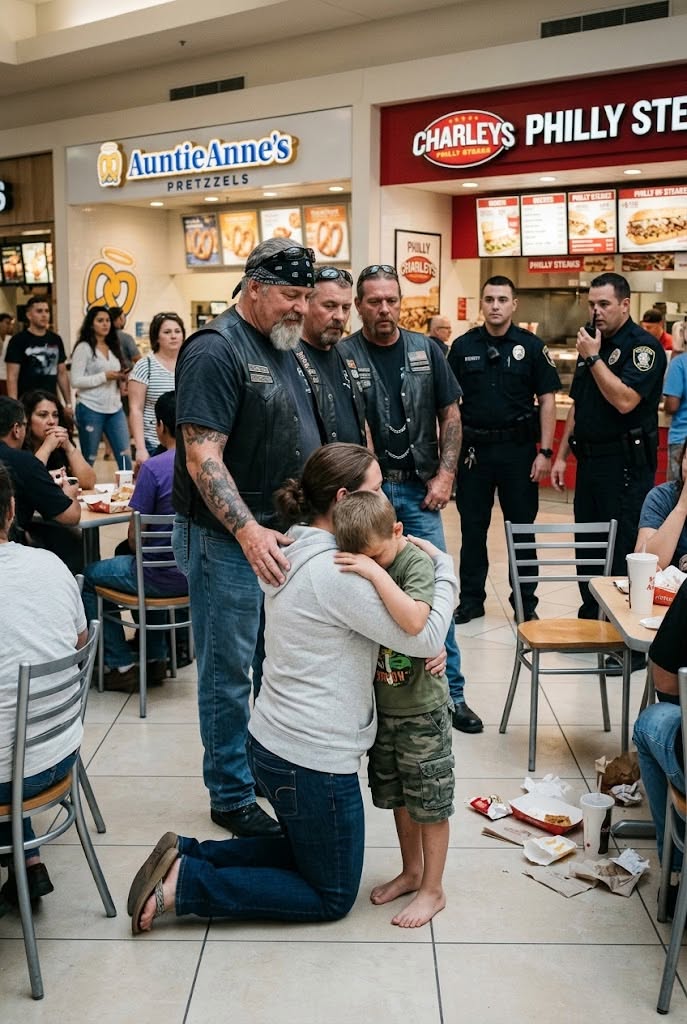
Except for the six men sitting at a corner table, all dressed in leather.
They rose together, almost as if they had rehearsed it. Their chairs scraped across the floor.
One of them was enormous, with a gray beard and an age that looked somewhere around sixty. He approached me and said, “Show me a picture of him.”
Then he asked, “What does he love?”
“Trucks,” I answered. “He always goes toward trucks.”
He turned to the others.
“Loading dock, parking garage, fence by the highway. Two men to each location. Move!”
They took off running.
Full-grown men in heavy boots sprinted through the mall while the security guards remained where they were, clutching their radios.
Eleven minutes later, the gray-bearded man’s phone rang. He immediately switched it to speaker.
A voice came through.
“I can see him. He’s standing on the shoulder of the northbound entrance ramp. Barefoot. About thirty feet from the traffic lane, watching the trucks go past.”
My knees buckled. The gray-bearded man caught me beneath the arm without even turning his head.
His name was Walt, though I hadn’t learned that yet.
“Is he moving toward the road?” Walt asked into the phone.
“No. He’s rocking back and forth. Whenever a semi passes, he flaps his hands and does these little hops. He looks happy, man. Like he’s watching a parade.”
“Where are you standing?”
“About forty yards behind him, near the fence. I haven’t spoken to him.”
“Good. Keep it that way. Don’t call his name, wave at him, or run toward him. Stay where you are and keep watching. We’re on our way.”
Walt ended the call and finally looked directly at me.
“Can you run?”
I ran.
We raced through the back of the food court, past a door marked employees only, and through a loading area where a young worker in an apron stared at us with his mouth hanging open.
Walt moved surprisingly fast for a man his age. He wasn’t jogging. He was running, his boots pounding against the concrete, while I struggled to keep up in sandals that kept twisting beneath my feet.
The gap in the fence was exactly where I had described it. Someone had bent the chain link aside years ago, and nobody had ever repaired it.
Beyond the opening, the ground sloped downward through weeds and broken glass toward the sound that had haunted my nightmares for eight years.
The highway roared like an ocean made entirely of engines.
At home, we have locks on every door, installed high enough that Owen can’t reach them. His bedroom window has an alarm. A GPS tracker is sewn into the tongue of his left shoe.
That same shoe was sitting on the floor mat of my car in the parking garage, right beside its matching shoe.
Then I saw him.
His green dinosaur shirt. His small, pale feet on the gray gravel. His back turned toward me, his face pointed at the road.
Tons of steel rushed past at seventy miles an hour, while my little boy rocked on his heels as if he were having the happiest day of his life.
Whenever a truck passed, his hands lifted and fluttered beside his ears.
That was his way of expressing happiness. He did the same thing whenever the garbage truck arrived on Tuesdays. I had a video of him doing it on my phone, one I had watched a thousand times.
I opened my mouth to scream his name.
Walt immediately covered it with his hand.
“If you shout, he’ll turn around to find you,” he whispered close to my ear. “And when he turns, he might take a step. You don’t know which direction he’ll move. Understand?”
I nodded against his palm.
He removed his hand and crouched beside me in the weeds, as quietly as if we were watching a wild animal.
“What does he do when he’s calm?” Walt asked. “Not excited. Calm.”
“He hums,” I whispered. “He presses his ear against things that vibrate. The dryer, the car door. He hums along with them.”
Walt studied the highway for several seconds. Then he looked back toward the fence, where two of the other bikers had just arrived through the opening.
One was built like a refrigerator. The other was a woman with a long gray braid that reached her belt.
“Marcus,” Walt called. “Go get Tully’s motorcycle. Walk it up the shoulder behind the boy. Keep the engine running. Move slowly. Don’t approach him directly. Pass him on the fence side like you’re just riding along. Rhonda, get into position in the lane.”
The woman didn’t hesitate.
She walked down the slope, crossed the rumble strip, and planted herself on the white line of the entrance ramp with her arms spread wide.
The first approaching car slammed on its brakes so hard I could hear the tires squeal.
Rhonda stood her ground. She pointed at the driver and then at the pavement until the car came to a complete stop.
Pete joined her. Then Sal.
Three bikers in leather stood in the middle of the entrance ramp with their backs to my son. Behind them, a line of cars began to form. Nobody honked. The drivers couldn’t see what was happening, but somehow, they seemed to sense that something serious was unfolding.
“They can’t stop the highway,” I said desperately.
“They don’t need to stop the highway,” Walt replied. “They only need to block this ramp. Nothing is getting onto that road from here. Now watch.”
That was when a semi on the main highway spotted Owen.
I heard the air horn before I understood what was happening. It was long and furious, the kind of blast truck drivers use when something dangerous appears in their path.
The driver had seen a barefoot child standing beside the road and reacted the only way he knew how.
Owen’s entire body jolted.
His hands flew upward.
Then he took one step toward the sound.
Just one step.
Toward the traffic lane.
A terrible sound escaped my throat, something I had never heard myself make before. Walt pressed his hand down firmly on my shoulder.
“Hold,” he said. “Hold on. He stopped. Look at him. He stopped.”
And he had.
Owen stood with one foot ahead of the other, swaying slightly, his head tilted as he listened to the horn fading into the distance.
He was twenty-five feet from the white line.
Those twenty-five feet became my entire world. I couldn’t look at anything else.
Then I heard the motorcycle.
Marcus was pushing Tully’s bike along the gravel, holding the handlebars with one hand while the engine idled. The low, rough sound reminded me of a large animal breathing steadily.
Owen’s hands stopped moving.
He didn’t turn around immediately. Instead, his whole body became perfectly still, something he often did when he heard an unfamiliar sound.
It was as if every part of him was listening.
His teacher called it his antenna going up.
Marcus continued walking, guiding the motorcycle past Owen on the fence side. He didn’t stare at the boy or slow his pace.
When he was about fifteen feet ahead, he stopped, steadied the motorcycle, and stood with his back to Owen as if he were simply waiting for a bus.
Owen turned around.
He turned away from the highway and toward the motorcycle.
I bit the inside of my cheek to keep myself from making a sound.
He walked toward it with his familiar little bounce. He paid no attention to Marcus. His eyes were fixed on the engine.
He placed both hands flat against the fuel tank, leaned forward, and rested his cheek against the metal.
Then I heard him begin to hum.
“Go,” Walt whispered. “Walk around to the other side of the bike. Don’t grab him. Just put your hand on the tank beside his.”
I barely remember crossing the gravel.
What I remember is the rough ground beneath my feet, Marcus standing perfectly still like a fence post, and myself kneeling on the opposite side of the motorcycle.
I slowly placed my hand on the warm metal, just an inch from Owen’s fingers.
He opened his eyes.
He looked at my hand.
Then he moved his own hand until his little finger touched mine.
He closed his eyes again and continued humming.
That was how Owen told me, I’m here.
I lowered my forehead onto the motorcycle’s tank and cried so hard I could barely breathe.
Someone switched off the engine. I never saw who did it.
When I finally looked up, Walt was standing above us. The three men who had blocked the ramp had climbed back up the slope, and all six bikers were gathered loosely around the motorcycle.
There was one small barefoot boy, one motorcycle, and one mother who had completely fallen apart.
Nobody said a word.
Rhonda handed me a bandana. It smelled of gasoline, but I used it to wipe my entire face.
“Thank you,” I managed to say. My voice sounded like a croak. “Thank you. I don’t even know any of your names.”
“Walt,” the gray-bearded man replied. “That’s Marcus, Rhonda, Pete, Sal, and the guy who found your boy is Tully. He’s going to want his motorcycle back before Marcus gets too attached to it.”
Tully, the man who had called earlier, was perhaps thirty years old. He was thin, with a small cross tattooed on his neck.
He walked toward us along the shoulder with his hands tucked into his pockets.
“I nearly called out to him,” he told me. “When I first spotted him, I almost shouted his name. Then I remembered what Walt said. I kept my mouth shut and watched him instead. Those eleven minutes felt like the longest of my life.”
“How did you know?” I asked Walt. “How did you know not to shout? And how did you know the motorcycle would help?”
He didn’t answer immediately.
Instead, he watched Owen, who had now sat down on the gravel and was running his fingers along the exhaust pipe.
“I drove the county’s special-needs school bus for twenty-two years,” he finally said. “Route 14. I worked with maybe forty kids like yours during that time. Nonverbal kids, runners, all kinds of needs. You learn what works. You also learn what can get a child killed.”
Then he said something I will never forget.
“You let go of his hand for one second. I’ve seen parents let go for an hour. I’ve seen parents lose their children forever. One second doesn’t make you neglectful, ma’am. It makes you a human being with two hands and a wallet. Don’t carry this blame.”
I nodded, although I wasn’t ready to believe him.
I think I’m beginning to believe him now.
Owen’s father had walked away for good when our son was four. He said he couldn’t handle it anymore.
His final words to me before leaving were that I was treating Owen like a baby, that he would be fine on his own, and that children figured things out for themselves.
I thought about those words while standing on the shoulder of Interstate 80.
Kids figure it out.
Kids wander off.
Everyone seems to have a sentence that makes it easier to walk away.
Getting Owen away from the motorcycle took forty minutes.
He refused to leave it. Every time I tried to lift him, his body stiffened completely, and he began making his high-pitched scream—the one that means he might hurt himself if someone doesn’t stop.
So the bikers didn’t force him to leave.
Instead, they walked the motorcycles.
All six men pushed their bikes along the shoulder, through the gap in the fence, across the loading area, and through the parking lot.
They moved at the pace of an eight-year-old who kept one hand on Tully’s handlebar and hummed the entire way.
Tully walked beside him on the opposite side, keeping his hand on the handlebar too. He matched Owen’s every step and never once looked down at him.
A semi slowed on the frontage road beside us.
The driver leaned out of his window and asked whether that was the boy.
Rhonda told him yes.
He explained that he was the one who had reported seeing Owen and that he’d been praying the entire time he drove down the ramp.
Then he gently pulled his horn cord twice.
Owen lifted his hands and fluttered them.
People sitting in their cars stared as we passed. One woman recorded the scene on her phone.
I didn’t care.
I had never been part of a more beautiful parade.
Mall security was waiting at the edge of the parking lot.
Both guards were there, along with a third man wearing a dress shirt, tie, and identification lanyard. I later learned he was the supervisor who had been at lunch.
His first words weren’t, “Is the boy okay?”
Instead, he started talking about the loading bay being a restricted area. He mentioned reports of unauthorized people running through the building and said he needed everyone’s names.
Walt brought his motorcycle to a stop.
The entire line behind him stopped too.
“My name is Walt Henning,” he said. “I was sitting in your food court when this mother told your guards that her nonverbal son was heading toward the highway. Your guard told her to wait fifteen minutes. I heard her ask for a Code Adam, and your other guard told her he couldn’t issue one without you. And you were at lunch.”
The supervisor began explaining something about procedures.
“Your procedures left an eight-year-old child standing beside Interstate 80,” Walt replied. He never raised his voice. “Write that beside my name.”
The younger guard, the one who had smiled at me, had turned as pale as paper.
He stared at Owen’s bare feet.
Then he looked toward the highway, which was still audible from where we stood, and finally lowered his eyes to the ground.
A state trooper arrived around that time.
Someone on the entrance ramp had reported a child on the shoulder and bikers blocking traffic. The trooper took one look at the six motorcycles and reached toward his belt.
Then Rhonda approached him and explained everything in about thirty seconds.
He removed his hand from his belt and took out his notebook.
He asked whether I wanted to give a statement about the mall’s response.
I said yes.
The supervisor explained that the mall would conduct its own internal investigation.
The trooper told him that was fine. He would conduct his own investigation as well. His report would state that six private citizens had recovered the child, not mall security, and that mall security had refused to initiate a Code Adam when the child’s mother requested one.
After that, the supervisor stopped talking.
Here’s the part I never expected.
Before the bikers left, Walt gave me his phone number. He wrote it on the back of a gas receipt.
He told me that if I ever brought Owen back to the mall, I should call him first. He and whichever members of the group were available would come have lunch with us at that corner table.
I thought it was a kind gesture. The sort of thing people say when they want to make you feel better.
Three Saturdays later, I called him.
Partly because Owen needed new shoes, and partly because I needed to prove to myself that I could walk into that building again.
When we arrived, four of the bikers were already waiting at the table.
Walt, Rhonda, Tully, and a man I’d never met before named Deacon.
Owen walked straight past the pretzel counter without slowing down. He headed directly to the table and climbed into the chair beside Walt as though it had been reserved for him.
Owen doesn’t do that.
He doesn’t approach strangers. In his entire life, he had never simply walked up to someone other than me or his grandmother and sat beside them.
Walt didn’t make a big deal out of it.
He simply pushed his fries toward the center of the table and continued talking to Deacon about a carburetor.
Owen ate eleven fries.
I counted every one.
That day, I bought him shoes with Velcro straps. This time, I sewed his GPS tracker into his sock.
An hour later, the younger security guard found me near the shoe store.
His name tag read Brandon.
He stood there awkwardly for a while before speaking.
He told me he’d been written up and admitted that he deserved it. He explained that he’d gone home that night and searched for the meaning of nonverbal. Then he looked up elopement. After that, he found a video showing a child on a highway in Texas.
He told me he hadn’t been able to sleep.
“I thought he was just a kid who’d wandered off,” he said. “I didn’t understand that some kids can’t find their way back.”
“Now you understand,” I replied.
“Now I understand.”
He explained that the mall had changed its rules. Any employee could now issue a Code Adam without waiting for a supervisor’s permission.
He said he’d pushed for the change.
I couldn’t be certain whether that was true, but I decided to believe him.
The final thing I want to tell you is about Walt.
On the day of the parade, after Owen finally released his grip on the handlebar in the parking lot, I asked Walt one last time how he knew.
I wasn’t asking about the motorcycle or the engine.
I wanted to know why six grown men had rushed through a mall for a child they’d never met.
Walt remained silent for a long time.
“1998,” he finally said. “There was a boy named Danny on my bus route. Nine years old. Nonverbal, loved water, and would walk straight toward anything blue. His family took him camping beside a lake, and he slipped out of the tent at five in the morning.”
Walt lowered his eyes toward his boots.
“It took the campground forty minutes to begin searching. Everyone assumed he’d turn up eventually. Kids wander off.”
He didn’t explain what happened next.
He didn’t have to.
“I promised myself that day that if I ever heard another mother scream like that, I wouldn’t sit around trying to figure things out. I’d stand up and do something.”
Owen loves drawing trucks.
That’s almost all he draws. Hundreds of them, in crayon, usually using the same green crayon until it’s worn down to nothing.
Two weeks after the incident at the mall, he drew a motorcycle.
Then he drew six of them.
Six motorcycles in a line, each carrying a little round man. One rider had a long braid. In front of the first motorcycle stood a stick figure with yellow hair, representing me, and a smaller stick figure without shoes.
I brought the drawing to Walt at the food court.
He studied it for a long time. Then he folded it with great care and slipped it inside his leather vest.
Rhonda told me later that he had taped it inside his motorcycle’s windshield.
In forty years of riding, she said, it was the only decoration he’d ever allowed on that bike.
Six bikers had stood up at once.
Everyone else in that food court had looked at me and then looked away.
I think about that every single day.
And then I think about the six men who didn’t look away.