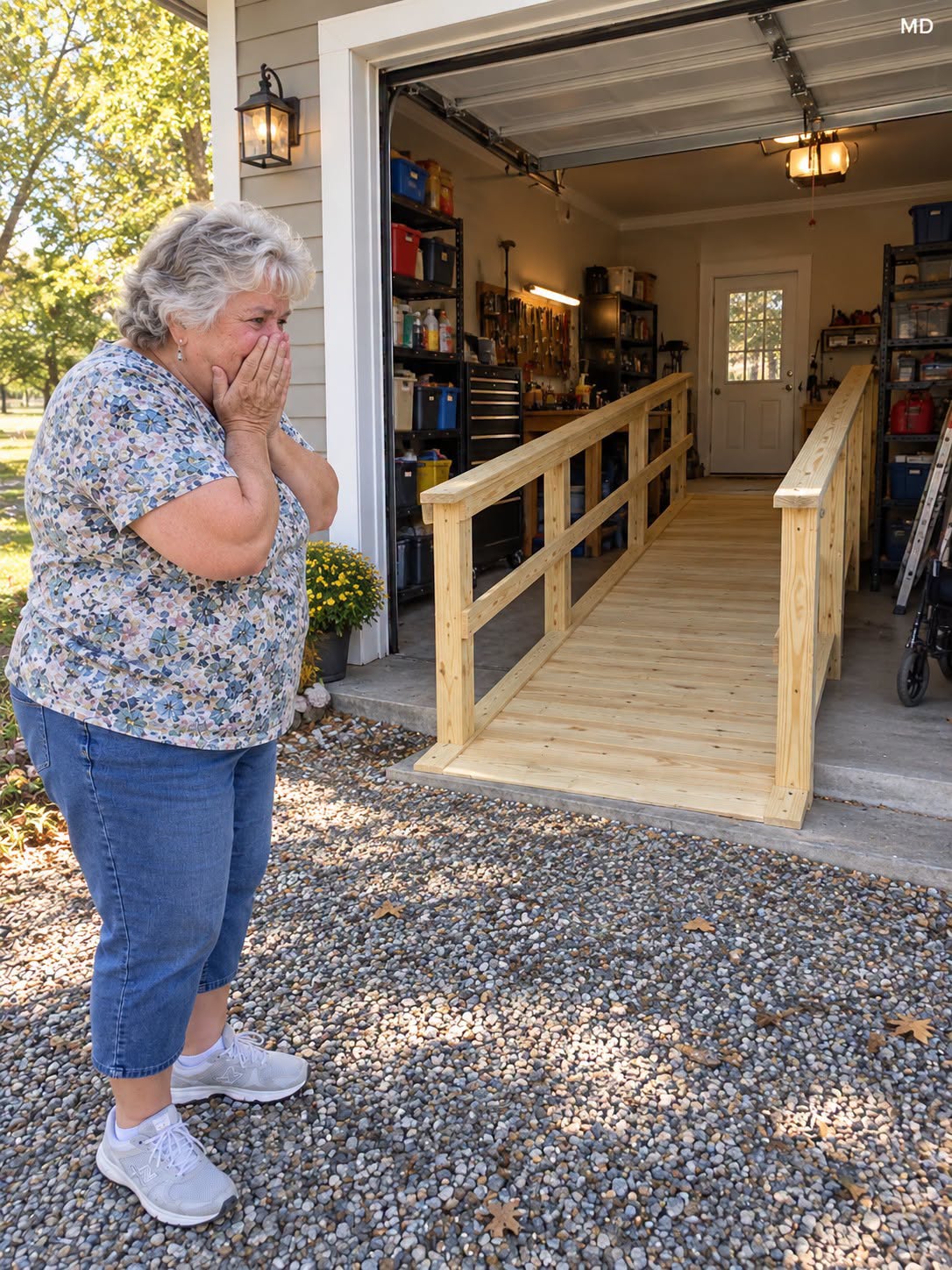
The garage door stood open, country music played softly, and the smell of fresh wood filled the air as Winona Pruitt stepped onto the gravel driveway. At 64, the retired ER nurse had spent two years grieving her husband, Dwight, before finding companionship with Wendell Haskins, a 66-year-old widower. Yet her son Zach had warned her that Wendell might be interested in Dwight’s life insurance money. After months of dating, Winona still had never seen Wendell’s home, and his repeated excuses were beginning to trouble her. Determined to discover the truth, she drove 40 minutes to his address, afraid of what she might find.
What she discovered was nothing like the betrayal she had imagined.
Wendell’s house sat at the end of a quiet country road, surrounded by tall oak trees and a small garden that looked as though someone had recently begun bringing it back to life. His pickup truck was parked beside the garage, and through the open door, Winona could see him working at a wooden table.
He was so focused that he didn’t notice her approaching.
“Wendell?” she called.
He turned suddenly, dropping the piece of sandpaper in his hand. For a moment, he simply stared at her.
“Winona? What are you doing here?”
She tried to smile, but the words came out more sharply than she intended.
“I could ask you the same question. We’ve been seeing each other for months, and every time I ask to visit your house, you find a reason why I shouldn’t.”
Wendell wiped his hands on an old towel. His expression changed from surprise to something Winona couldn’t quite identify.
Shame, perhaps. Or fear.
“I should have told you,” he said quietly.
“Then tell me now.”
He looked toward the workbench behind him. Several pieces of carefully cut wood lay beside a half-finished rocking chair. On a nearby shelf sat a framed photograph of a young woman holding a little girl.
Winona recognized the woman immediately.
It was Wendell’s daughter, Rebecca, who had died in a car accident six years earlier.
The little girl in the photograph was his granddaughter, Emily.
Winona had heard about them during their long conversations over dinner, but Wendell rarely spoke about the years following Rebecca’s death. She knew he had become distant after losing his wife and daughter, but she had never understood just how deeply the tragedies had affected him.
“Come inside,” he said. “There’s something you need to understand.”
Winona followed him through the garage and into a modest house. The living room was clean but almost painfully quiet. A few family photographs lined the mantel, and a blanket was folded neatly over an armchair.
On the kitchen table sat a stack of envelopes, several unpaid bills, and a small notebook filled with handwritten figures.
Wendell noticed her looking at them.
“Those are mine,” he explained. “I haven’t been very good at keeping everything organized since my wife died.”
“Is that why you never invited me here?”
He lowered his eyes.
“Partly.”
Then he took a long breath and told her the truth.
After Rebecca’s death, Wendell had become responsible for helping his son-in-law raise Emily. The little girl had struggled with the loss of her mother, and Wendell had spent years trying to be a steady presence in her life. When his own wife later died, the house became a place filled with memories he could barely bear to face.
He had stopped inviting people over. He let the garden grow wild, neglected repairs, and spent most of his free time in the garage, where working with wood gave his restless mind something to concentrate on.
“I wasn’t hiding another woman,” he said. “And I wasn’t trying to hide money. I was hiding the fact that I hadn’t figured out how to live in this house anymore.”
Winona felt the tension in her shoulders begin to ease.
But one question remained.
“Why didn’t you just tell me?”
Wendell looked at her with tired, honest eyes.
“Because when you’re a man in your sixties, people expect you to have everything figured out. They think you’ve already lived your life, made your mistakes, and learned how to handle loss. I didn’t want you to see how broken I still felt.”
Winona sat down across from him.
For two years after Dwight’s death, she had heard people tell her to stay strong. They praised her for returning to normal life, for helping her neighbors, and for smiling at family gatherings. Almost nobody asked whether she was lonely when the house grew quiet at night.
She understood more than Wendell realized.
Still, she couldn’t ignore the warning her son had given her.
“Zach thinks you’re interested in Dwight’s life insurance money,” she admitted.
Wendell went completely still.
Then he shook his head.
“I can understand why your son wants to protect you. If I were in his position, I’d probably ask questions, too. But Winona, I’ve never asked you for money. I never would.”
He walked to a drawer, removed a folder, and placed it on the table.
Inside were documents showing that his house belonged to him and that he had been managing his own finances. He wasn’t wealthy, but he wasn’t looking for someone to rescue him, either.
“I don’t need your husband’s money,” he said. “I need someone who understands that losing the people you love doesn’t mean you stop wanting someone beside you.”
Winona looked down at the papers, then back at the man she thought she knew.
She realized she had driven there expecting to uncover a lie. Instead, she had found a man who had been too embarrassed to reveal his grief.
But she also knew that trust couldn’t be built on assumptions or hidden truths.
“If we’re going to continue this relationship,” she said, “we can’t keep secrets from each other. I won’t let fear make decisions for me, and I won’t let loneliness make them either.”
Wendell nodded.
“That’s fair.”
She stayed for another hour. He made coffee, and she watched him sand the rocking chair in the garage. He explained that he was building it for Emily, who had recently told him she wanted something made by hand that she could keep forever.
As Winona prepared to leave, she paused beside the workbench.
“Would you mind if I came back next weekend?”
Wendell looked up, surprised.
“You mean that?”
“I do. But next time, you’re making dinner.”
For the first time that afternoon, his smile reached his eyes.
When Winona returned home, Zach was waiting for her. He immediately asked what she had discovered.
She told him about the house, the photographs, the unfinished rocking chair, and Wendell’s explanation.
Zach listened carefully, still cautious.
“Mom, I just don’t want you getting hurt again.”
Winona reached for his hand.
“I know, sweetheart. And I appreciate that. But protecting me doesn’t mean deciding that everyone who comes into my life has bad intentions. I’ll be careful. I’ll ask questions. And I’ll take my time.”
Over the following weeks, Winona and Wendell began spending more time together at his home. She helped him plant flowers in the garden, and he taught her how to sand and finish a wooden picture frame. They talked about their spouses, sometimes laughing over old memories and sometimes sitting quietly when the sadness returned.
Nothing about their relationship was perfect. There were awkward conversations, moments of doubt, and days when grief made them withdraw from each other.
But they learned to speak honestly instead of hiding behind excuses.
Months later, Wendell finished Emily’s rocking chair. Winona helped him deliver it, and the little girl hugged him so tightly that he had to bend down to keep his balance.
Watching them together, Winona understood something she had nearly forgotten during the years after Dwight’s death.
A new beginning doesn’t erase the past. It simply makes room for something else beside it.
Zach eventually grew more comfortable with Wendell, although he continued to look out for his mother. Wendell never asked Winona for financial help, and she never felt pressured to prove her love by giving up her independence.
Their relationship grew slowly, built on ordinary things: shared meals, afternoon walks, quiet conversations, and the willingness to tell the truth even when the truth was uncomfortable.
Winona had driven forty minutes that day expecting to discover a betrayal.
Instead, she discovered that sometimes the person we fear is hiding something isn’t hiding a scheme at all. Sometimes they’re hiding their pain because they don’t know how to explain it.
And sometimes, the most important question isn’t whether someone has a perfect past or a spotless home.
It’s whether they’re willing to open the door, tell the truth, and let you see who they really are.
Because love later in life isn’t about replacing what was lost. It’s about finding the courage to live again without pretending the loss never happened.