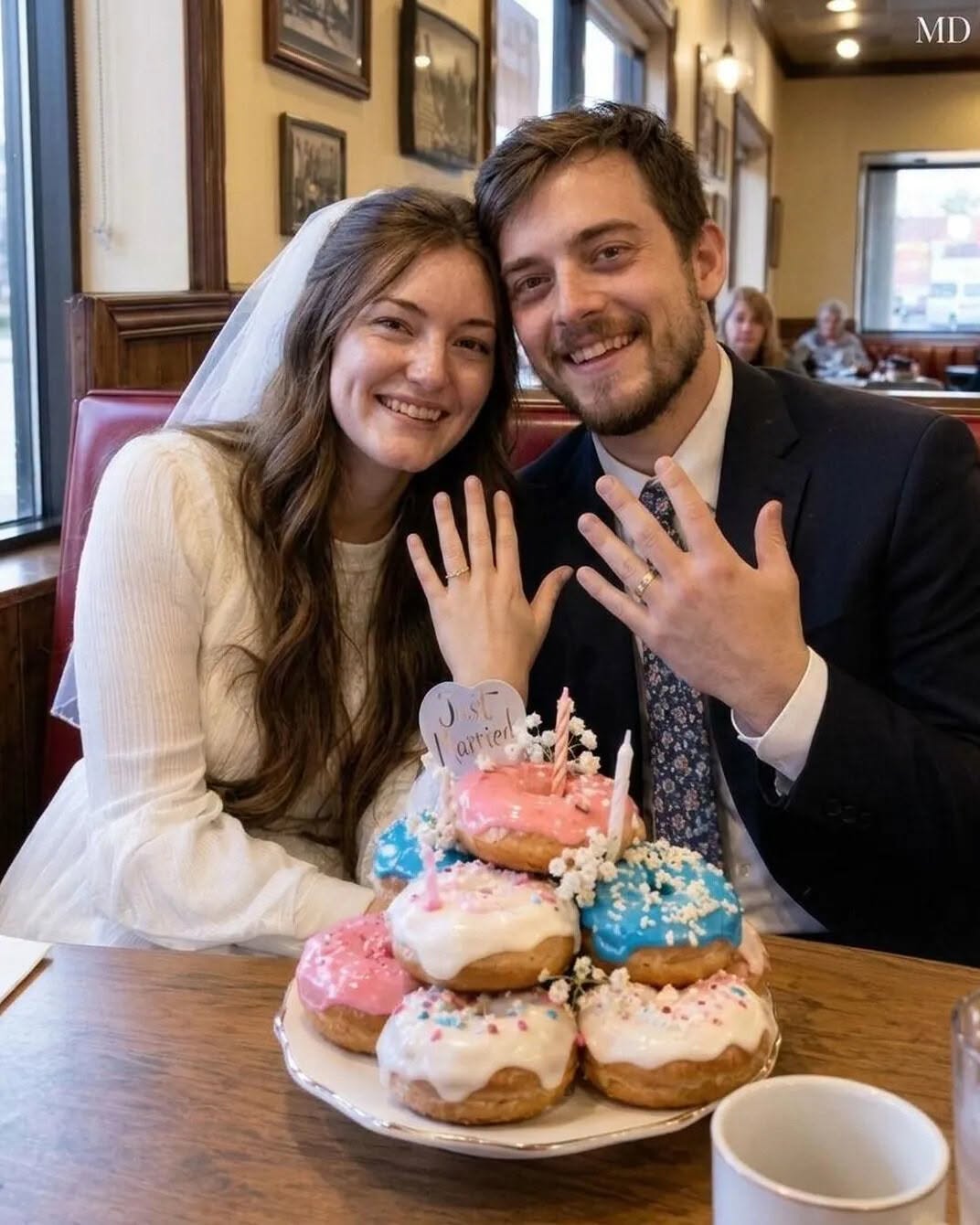
My sister Sandra burst into laughter the moment she saw the little tower of glazed donuts sitting on our diner table, turning what should have been a happy wedding celebration into a humiliating scene.
“An eighteen-dollar donut cake?” she scoffed, loud enough for nearby customers to turn around.
My new husband, Aaron, stood beside the table holding the homemade creation he had carefully assembled after our courthouse wedding, while both sets of parents watched in uncomfortable silence. Sandra had spent years insisting I should marry Samuel, a wealthy businessman with luxury homes and expensive tastes, rather than the man I genuinely loved.
According to Sandra, love was a nice idea, but money was what made a marriage successful.
She had never hidden her disappointment in Aaron. He worked long hours, drove an older car, and preferred simple pleasures over expensive luxuries. He wasn’t the kind of man who arrived at family gatherings wearing designer suits or bragging about his latest investments. But he was the man who stayed beside me when my mother was ill, who remembered every little thing that made me happy, and who had never once made me feel that I wasn’t good enough.
That was why I married him.
We had chosen a courthouse wedding because we wanted to begin our life together without taking on debt just to impress other people. After the ceremony, Aaron surprised me by taking me to the little diner where we had shared our first date.
He had brought a small box of glazed donuts, arranged carefully into a tower with a ribbon around the base. It wasn’t extravagant, but he had spent his morning putting it together himself.
He knew I loved donuts, and he remembered that on our first date, we had joked about having a donut cake if we ever got married.
To me, that little tower was worth more than the most expensive wedding cake in the world.
To Sandra, it was an opportunity to remind everyone how much better she believed her life was than mine.
She leaned back in her chair, shaking her head in disbelief.
“I honestly thought you would have something better than this,” she said. “You only get married once, hopefully. Couldn’t Aaron have made a little effort?”
Aaron looked down at the donuts, then at me. I could see the hurt in his eyes, but he didn’t respond with anger.
Instead, he gently placed the box on the table.
“I made it because she likes them,” he said quietly.
Sandra laughed again.
“That’s exactly my point! You’re celebrating a wedding, not a child’s birthday party.”
My cheeks burned. I wanted to tell her to stop, but the words caught in my throat. I had spent so many years trying to keep the peace with Sandra that standing up to her felt almost impossible.
Then she turned toward our parents.
“Mom, Dad, you have to admit this is ridiculous. She could have married Samuel and lived in a beautiful house, traveled the world, and never worried about money again. Instead, she’s celebrating with eighteen dollars’ worth of donuts.”
My father cleared his throat, clearly uncomfortable. My mother stared at her coffee.
Sandra mistook their silence for agreement.
Then Aaron did something none of us expected.
He pulled out a chair, sat beside me, and took my hand.
“Before you judge our marriage by the price of our cake,” he said calmly, “there’s something I think everyone should know.”
Sandra folded her arms.
“Oh, this should be good.”
Aaron reached into the inside pocket of his jacket and removed a plain envelope. He placed it on the table but didn’t open it immediately.
“I never wanted to discuss money at our wedding celebration,” he began. “I don’t believe a person’s worth should be measured by their bank account. But since money seems to be the only thing that matters here, perhaps it’s time to clear up a misunderstanding.”
Sandra’s smile faded slightly.
She had always assumed Aaron was struggling financially. She had never asked about his work in any detail because she considered his job unimportant. Whenever he tried to explain what he did, she would interrupt him to talk about Samuel’s latest business deal.
Aaron continued.
“For the past twelve years, I’ve worked with a small technology company. I started as an engineer, and eventually I became one of the people responsible for building its core software. We spent years developing a product that helps businesses manage complicated financial operations.”
He paused and looked at me.
“I didn’t tell you much about the company because I wanted our relationship to be about us, not my work. And I didn’t want to make promises about money that might never materialize.”
I squeezed his hand.
I knew he worked in technology, but I had never understood how significant his role might be. He had always been modest about his accomplishments and preferred talking about his team rather than himself.
Sandra rolled her eyes.
“So you’re a programmer. Congratulations. That still doesn’t explain the donuts.”
Aaron nodded.
“You’re right. It doesn’t.”
He opened the envelope and removed a document.
“Last month, the company completed a major acquisition. The founders and early employees received compensation under the terms of the agreement. After years of work, I finally have financial security that I never expected to have this early in my life.”
My father leaned forward.
“What does that mean, exactly?”
Aaron explained that the acquisition had made his shares worth substantially more than they had been before. He had also received a promotion and would continue working with the company through its next stage of growth.
He didn’t announce an enormous figure or claim that he was secretly a billionaire. He simply explained that the years he had spent building something useful had finally paid off.
Sandra stared at him.
“But you drive that old car,” she said.
Aaron smiled faintly.
“It still works.”
“And you rent a small apartment.”
“We like it. We’re saving for a home we actually want, rather than buying one to impress people.”
“And you never mentioned any of this?”
“I didn’t think I needed to prove myself to your family.”
The silence that followed was unlike anything I had experienced at a family gathering.
For years, Sandra had treated Aaron as though he were a temporary disappointment in my life. She had assumed that his modest lifestyle meant he lacked ambition, intelligence, and the ability to provide a secure future.
Now she was discovering that she had judged him without ever bothering to understand him.
But Aaron wasn’t finished.
He turned toward my parents.
“The financial news is important, but there’s something else I want you to understand. I married your daughter because I love her. If the acquisition had never happened, I would still have married her. If I had to start over tomorrow, I would still choose her.”
His voice softened as he looked at me.
“I didn’t make that donut cake because I couldn’t afford something better. I made it because it was part of our story. I wanted our first celebration as husband and wife to remind us of the beginning, not to impress people who weren’t there when we fell in love.”
My eyes filled with tears.
I remembered our first date: two people sharing a small table, laughing over a box of donuts, neither of us imagining that we would one day sit in that same diner as husband and wife.
Aaron had remembered every detail.
Sandra had remembered only the price.
Then Aaron turned back to her.
“And there’s one more thing. You keep saying your sister should have married Samuel because he’s wealthy. But have you ever asked whether Samuel was the right person for her?”
Sandra’s expression hardened.
“Samuel is successful. He could give her anything.”
“Could he give her kindness? Respect? Loyalty? Could he sit beside her during a difficult night without making her feel like a burden? Those are the things I wanted to bring into this marriage.”
Nobody spoke.
Aaron didn’t insult Sandra or try to humiliate her in return. He simply gathered the documents, put them back in the envelope, and returned his attention to me.
“Come on,” he said gently. “Let’s enjoy our wedding.”
For a moment, I considered leaving with him immediately. Part of me wanted Sandra to feel the embarrassment she had caused me. But another part of me realized that this day wasn’t about winning an argument with my sister.
It was about beginning my life with the man I loved.
So I picked up one of the glazed donuts, broke it in half, and offered him the first bite.
“To us,” I whispered.
He smiled.
“To us.”
My mother began to cry quietly. My father stood up, walked around the table, and shook Aaron’s hand.
“I owe you an apology,” he said. “I’ve allowed appearances to matter too much. I should have taken the time to get to know you.”
Aaron accepted his apology warmly.
Sandra, however, remained silent.
For the first time in years, she had no clever remark ready. She looked at the little donut tower, then at the envelope, and finally at me.
“I didn’t know,” she murmured.
I looked at her for a long moment.
“That’s the problem, Sandra. You never tried to know him.”
She opened her mouth as though she wanted to argue, but nothing came out.
I wasn’t interested in making her feel small. I simply wanted her to understand that my happiness was not an invitation for her to judge my choices.
We spent the rest of the afternoon eating donuts, drinking coffee, and talking about our plans for the future. Aaron and I discussed the possibility of buying a home one day, but we agreed that we would do it when it felt right for us.
We didn’t need a mansion to prove our marriage was successful.
We needed a home where we could laugh, disagree without cruelty, support each other through difficult seasons, and grow old knowing that neither of us had to earn the other’s respect.
Over the following weeks, Sandra’s attitude began to change. She called more often and asked Aaron about his work. At first, her questions seemed motivated by curiosity about his financial success, but gradually she began listening to his answers instead of interrupting him.
I didn’t pretend that one conversation had erased years of hurt. Trust takes longer to rebuild than it takes to damage, and I wasn’t willing to forget how she had treated the man I loved simply because she had discovered that he was successful.
Still, I left room for her to do better.
Months later, Aaron and I celebrated our first anniversary at the same little diner. We ordered glazed donuts again, laughing as we remembered the scene that had nearly ruined our wedding day.
By then, we had begun saving for a house. We had plans, hopes, and challenges ahead of us, just like every other couple. The difference was that we were building our future according to our own values.
Aaron reached across the table and took my hand.
“Do you regret not having a big wedding?” he asked playfully.
I looked at the man who had stood beside me when my own sister tried to make me feel ashamed of my happiness.
“Not for a second,” I replied.
Because that day taught me something I will never forget: the price of a celebration tells you nothing about the value of the love being celebrated.
Some people measure success by expensive gifts, impressive homes, and the admiration of strangers. Others measure it by the quiet promises kept when nobody is watching.
And sometimes, the person everyone underestimates is the one who understands what truly matters.
Our wedding cake cost eighteen dollars.
But the love, loyalty, and respect behind it were priceless.