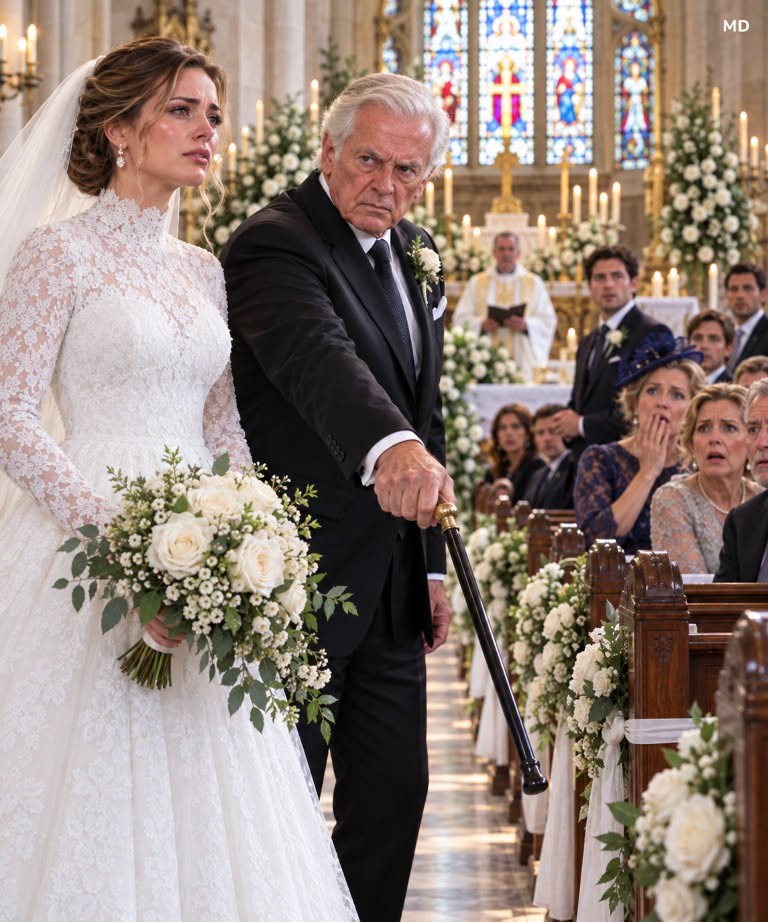
The church doors opened, and for one long second, I could hear nothing except the soft scrape of my grandfather Arthur’s cane against the floor. At 81, he stood beside me in his navy suit, his hand wrapped firmly around mine as we started down the white runner. My mother, Margaret, sat in the front pew wearing the same pearls she had worn when she proudly walked my sisters Paige and Lauren down the aisle. Only hours earlier, she had looked at me in my wedding dress and said, “I refuse to walk my greatest regret to the altar.”
My name is Emily, and for most of my life, I had tried to earn my mother’s approval. I studied hard, followed her rules, and spent years believing that if I made the right choices, she would eventually look at me with the same pride she showed my sisters. Paige was the successful one, Lauren was the charming one, and I was the daughter who never seemed to measure up.
When my sisters got married, my mother cried happy tears, helped them choose their dresses, and proudly walked them toward their husbands. When I announced my engagement to Daniel, the man who had loved me through my worst days and celebrated my smallest victories, she barely smiled.
“He’s a nice man,” she told me once, “but I expected more for you.”
I asked what she meant, but she simply changed the subject.
As the wedding approached, her disapproval became impossible to ignore. She criticized my simple dress, questioned our decision to hold a modest ceremony, and repeatedly reminded me that my sisters had planned much more impressive weddings. I tried to laugh it off, telling myself that wedding planning made everyone emotional.
Then, on the morning of my wedding, I stood in my childhood bedroom while my mother adjusted her pearls in the mirror.
“Mom,” I said quietly, “would you walk me down the aisle?”
She turned toward me, her expression cold.
“I refuse to walk my greatest regret to the altar.”
For a moment, I couldn’t breathe. I had imagined many things she might say, but nothing could have prepared me for those words. I waited for her to soften, to explain that she was angry or simply having a bad day.
She didn’t.
Instead, she picked up her handbag and left the room.
I sat on the edge of the bed, careful not to wrinkle my dress, and cried until my makeup began to run. I wondered what was so wrong with me that my own mother couldn’t bear to walk beside me on the happiest day of my life.
Then someone knocked gently on the door.
It was my grandfather Arthur.
He had overheard the argument from the hallway. He didn’t ask me to explain or tell me that my mother didn’t mean it. He simply sat beside me, took my hand, and waited until I was ready to look at him.
“Your mother may have forgotten something important,” he said.
“What?”
“That being a parent is not about deciding which child makes you look the best. It’s about loving the child who needs you, even when the world doesn’t understand them.”
I broke down again, and he pulled me into his arms.
Then he stood, straightened his navy jacket, and offered me his arm.
“If your mother won’t walk you down that aisle, sweetheart, you’ll have to settle for the best-looking eighty-one-year-old man in the building.”
For the first time that morning, I laughed.
And now, as we walked toward the altar, every step felt like a small victory. I saw my friends smiling through tears. I saw Daniel waiting at the front, his eyes shining as he watched us approach. And I saw my mother sitting rigidly in the front pew, her lips pressed together.
When we reached Daniel, Grandpa Arthur placed my hand in his.
“Take care of her,” he said, his voice trembling. “She’s spent too much of her life wondering whether she’s enough. Make sure she never has to wonder that with you.”
Daniel squeezed my hand.
“I promise.”
Grandpa kissed my forehead and stepped aside. Before he returned to his seat, I hugged him tightly and whispered, “Thank you for choosing me.”
He looked confused for a second, then his eyes filled with tears.
“Emily, I’ve never had to choose you. You’ve always been my girl.”
The ceremony began, and for the first time that day, I stopped worrying about my mother. I listened to Daniel’s vows, promising to stand beside me in difficult times, to celebrate my victories, and to love me without asking me to become someone else.
When it was my turn, I promised him the same.
As we exchanged rings, I realized that a wedding wasn’t a performance designed to earn applause from the people who raised you. It was the beginning of a life built with someone who chose to stand beside you.
After the ceremony, guests gathered outside the church to congratulate us. Grandpa Arthur held my hands and told me how beautiful I looked. Daniel’s parents hugged me as if I had always belonged to their family.
Then my mother approached.
“Emily, can we talk?” she asked.
Daniel started to step closer, but I gently squeezed his hand and followed her a few feet away.
She glanced toward the guests before speaking.
“You embarrassed me today,” she said. “Everyone noticed your grandfather walking you down the aisle. People are going to ask questions.”
I stared at her, stunned.
“You told me I was your greatest regret, Mom. And you’re worried about what people will ask?”
Her face tightened.
“I was upset. You know how I get when things don’t go the way I expect.”
“I know how you get when things don’t go your way,” I replied. “But I’m not going to spend the rest of my life pretending your words don’t hurt just to make you comfortable.”
For the first time, she seemed to have no answer.
I took a breath and continued.
“I wanted you beside me today. I wanted my mother to be proud of me. But I can’t keep chasing your approval while convincing myself that every cruel thing you say is somehow my fault.”
Her eyes flickered toward the church doors.
“So what are you saying?”
“I’m saying I love you, but I won’t let your opinion decide how much I believe in myself anymore.”
I returned to Daniel before she could respond.
The reception was small, warm, and filled with laughter. Grandpa Arthur insisted on dancing with me, even though his knees protested every step. When the music slowed, he rested one hand on my shoulder.
“Are you happy, sweetheart?” he asked.
I looked across the room at Daniel, who was laughing with our friends.
“Yes,” I said. “I really am.”
“Good. Then don’t let anyone convince you that today was less beautiful because someone refused to stand beside you.”
I leaned against him, holding back tears.
Months passed after the wedding. My relationship with my mother remained complicated. Sometimes she called as if nothing had happened. Other times, she made small comments that reminded me how little had changed. I stopped arguing and started setting boundaries. I answered when I felt ready, left conversations when they became hurtful, and stopped apologizing for the life I had chosen.
It wasn’t easy. Part of me still wished she would call one day and say she was sorry. But I began to understand that healing didn’t require me to wait for an apology that might never come.
One afternoon, I visited Grandpa Arthur with our wedding album. He turned the pages slowly, smiling at the photographs of Daniel and me beneath the church arch.
When he reached the picture of us walking down the aisle together, he stopped.
“This is my favorite,” he said.
“Even though I’m looking at the floor?”
“Especially because you’re looking at the floor. You were probably trying not to cry.”
I laughed and rested my head against his shoulder.
Then he pointed to the photograph of Daniel waiting at the altar.
“Remember something, Emily. The people who love you won’t always say everything perfectly. But real love should never make you feel ashamed of being who you are.”
I held those words close long after I left his house.
My mother had called me her greatest regret, but my grandfather had shown me that I was never a regret to the people who truly loved me. I was a granddaughter, a wife, a friend, and a person worthy of kindness, even when someone I loved couldn’t see it.
And when I look back at my wedding day now, I don’t remember my mother’s cold expression or the cruel words she spoke in my bedroom.
I remember the sound of Grandpa Arthur’s cane against the church floor. I remember his trembling hand holding mine. I remember Daniel’s face when he saw me coming toward him.
Most of all, I remember the lesson that changed my life: Sometimes, the person who refuses to walk beside you teaches you exactly who deserves a place in your future.
And sometimes, the family that makes you feel most loved isn’t the family you were born into, but the people who remind you, through their actions, that you were always enough.