I thought my father-in-law would never stop treating my kitchen like his personal buffet. He ignored every warning, laughed at my complaints, and acted like I had no say in my own home. But when my husband finally witnessed it for himself, he did something neither of us expected. And what happened next left me speechless.
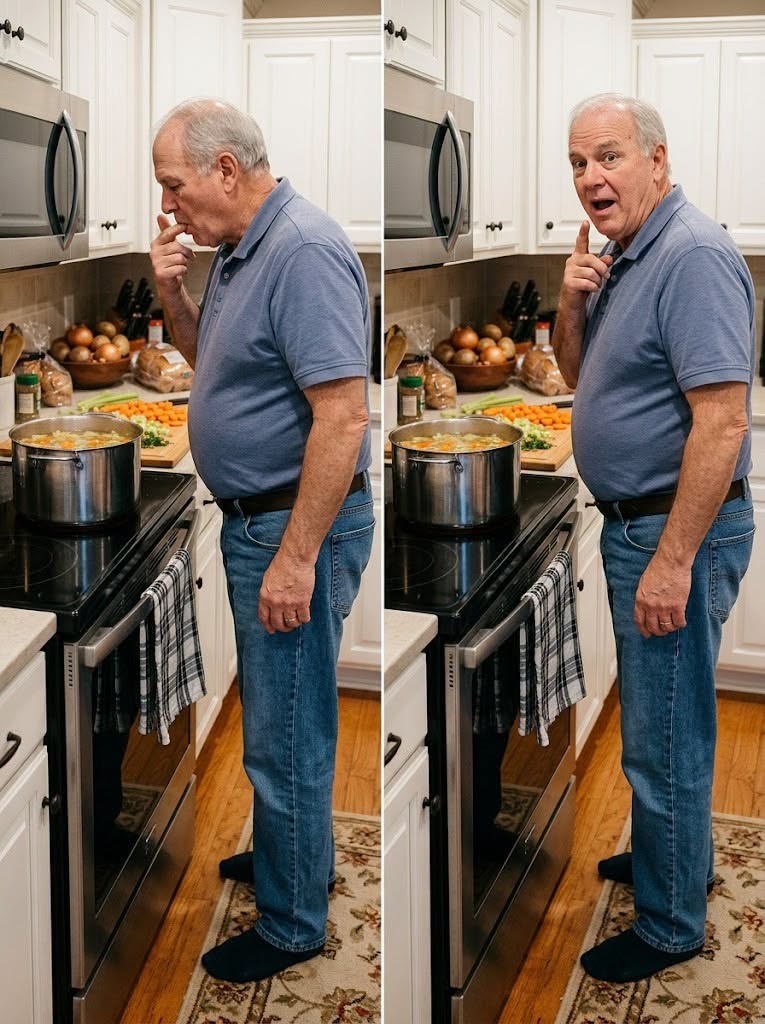
My father-in-law waited until I turned my back, then sneaked into my kitchen and stuck his fingers into whatever I was cooking.
Soup.
Gravy.
Sauce.
It didn’t matter what I was making. If something was simmering on the stove, he believed he had every right to taste it with his bare hands.
The first time it happened, I thought it was an accident.
I was preparing dinner when I turned around and saw him dipping two fingers into a pot of homemade gravy.
“Please don’t do that,” I said, trying to remain polite. “If you want to taste something, just ask me for a spoon.”
He laughed as if I’d told him a joke.
“What’s the problem? I’m family!”
I handed him a spoon and returned to cooking, hoping that would be the end of it.
It wasn’t.
The next day, he dipped his fingers into my soup. A few days later, I caught him tasting the sauce I had prepared for dinner. Every time I confronted him, he gave me the same dismissive smile.
“People are too sensitive these days,” he would say.
I tried explaining that it wasn’t just about manners. I was preparing food for several people, and putting unwashed fingers into shared dishes was unhygienic.
He acted as though I had insulted him.
“You’re making a big deal out of nothing,” he replied. “I’ve been eating like this my whole life.”
My husband, Daniel, initially tried to keep the peace.
“That’s just how Dad is,” he told me one evening. “He probably doesn’t even realize he’s upsetting you.”
“But I’ve told him repeatedly,” I answered. “He knows exactly what he’s doing.”
Daniel promised to speak to him, but nothing changed.
His father continued entering my kitchen whenever he pleased, tasting food with his fingers and leaving me feeling like a guest in my own home.
What made it worse was the way he behaved when other people were around. He would boast about how much he loved my cooking, then laugh about how he liked to sneak little tastes before dinner.
Everyone seemed to find it amusing.
I didn’t.
I had begun dreading the moment I needed to turn away from the stove. I would catch myself watching him instead of concentrating on the meal, worried that he would reach into another pot.
Then came the Sunday dinner that changed everything.
Daniel’s parents were visiting, and I had spent most of the afternoon preparing a meal. There was roasted chicken in the oven, vegetables on the counter, and a large pot of creamy potato soup simmering on the stove.
My father-in-law, Richard, wandered into the kitchen while I was cutting bread.
I heard the familiar sound of a spoon touching the pot, followed by his quiet chuckle.
I turned around.
There he was, dipping his bare fingers into the soup.
“Richard, please stop!” I said, louder than I intended.
He looked at me, grinned, and lifted his fingers toward his mouth.
“Just checking whether it’s ready.”
“That’s enough,” I said. “I’ve asked you so many times. Please don’t put your fingers into food I’m serving to everyone.”
He rolled his eyes.
“Then don’t invite me to dinner if you’re going to complain about everything!”
I stood there, exhausted and embarrassed. I could feel tears gathering in my eyes, but I refused to let them fall.
Then I heard a voice behind me.
“Dad, what are you doing?”
Daniel was standing in the doorway.
For a moment, nobody moved.
My father-in-law quickly pulled his hand away from the pot.
“Nothing,” he replied. “I was tasting the soup.”
“With your fingers?” Daniel asked.
Richard shrugged. “It’s my family. What’s the problem?”
Daniel walked into the kitchen and looked at me. I didn’t have to explain anything. The frustration on my face told him what words hadn’t been able to communicate before.
He turned back to his father.
“She has asked you not to do this. Why won’t you respect that?”
Richard laughed nervously.
“Oh, come on, Daniel. Don’t start taking sides over a little soup.”
“I’m not taking sides,” my husband answered calmly. “I’m asking you to respect my wife in her own home.”
His father looked genuinely offended.
“So now I’m not welcome in my son’s house?”
“You’re welcome here,” Daniel replied. “But that doesn’t mean you can ignore our rules.”
I had never heard my husband speak to his father that way.
Richard folded his arms and muttered something about how families used to be different. Then he looked at me as though he expected me to apologize for making him uncomfortable.
I said nothing.
Daniel surprised me again.
He walked over to the stove, turned off the burner, and lifted the pot of soup away from the heat.
“We’re not serving this,” he said.
My eyes widened.
“Daniel, I can make another batch,” I offered quietly.
“No, you don’t have to do that.” He looked at me with an expression I hadn’t seen before: genuine understanding. “You’ve already spent hours cooking. We’re ordering dinner tonight.”
Then he turned to his father.
“And if you put your fingers into the food again after being asked to stop, you’ll have to leave the kitchen. If it keeps happening, we’ll arrange visits somewhere else.”
Richard stared at him in disbelief.
“You would really send your own father away over something so small?”
Daniel didn’t raise his voice.
“No, Dad. This isn’t about soup. It’s about the fact that you’ve repeatedly ignored my wife’s boundaries, and I’ve allowed it to continue because I didn’t want an argument.”
He paused before adding, “That was my mistake.”
Those words nearly brought me to tears.
For months, I had felt as though I were fighting this battle alone. Hearing my husband acknowledge that he should have stepped in sooner meant more to me than he probably realized.
Richard grumbled and left the kitchen.
The rest of the evening was uncomfortable. We ordered food, and his father barely spoke to either of us. I worried that the confrontation would create a family rift, but Daniel assured me that respecting our home was not an unreasonable expectation.
Later that night, after his parents had left, I sat beside Daniel on the couch.
“Thank you,” I whispered.
He took my hand.
“I’m sorry I didn’t take you seriously the first time you told me. I thought keeping the peace meant ignoring the problem. I understand now that it only meant leaving you to deal with it alone.”
We talked for a long time about boundaries, respect, and the difference between welcoming family and allowing someone to disregard our comfort.
A few days later, Richard called.
I expected another complaint.
Instead, he cleared his throat and said, “Your husband tells me I owe you an apology.”
I waited.
“I suppose I got carried away. I didn’t think it bothered you that much.”
I gently explained that the problem had never been his wanting to taste my cooking. I would happily offer him a sample whenever he asked. The problem was that he kept doing something I had repeatedly asked him not to do.
There was a long silence.
“All right,” he finally said. “I’ll use a spoon next time.”
It wasn’t the most heartfelt apology in the world, but it was a start.
The next time Richard visited, I was preparing a pot of vegetable soup. He entered the kitchen, glanced at the stove, and reached for a spoon.
Then he stopped and looked at me.
“May I taste it?”
I smiled and handed him a clean spoon.
“Of course.”
He tasted the soup, nodded approvingly, and returned the spoon to the sink.
It was such a small gesture, but I felt an enormous sense of relief.
Our relationship didn’t become perfect overnight. Richard still had opinions about how I cooked, and occasionally he slipped back into his old habits of making jokes at my expense. But the kitchen incident had established something important: my husband and I were a team, and our home had boundaries that applied to everyone.
I had once believed that keeping a family together meant tolerating whatever made other people comfortable, even when it made me miserable.
Now I understood that genuine family harmony requires something different.
It requires respect.
The biggest surprise wasn’t that my husband finally confronted his father. It was that he recognized the real problem wasn’t a dirty finger in a pot of soup—it was the repeated belief that my feelings didn’t matter.
And sometimes, the most loving thing a partner can do isn’t to keep everyone happy.
It’s to stand beside the person who has been asking to be heard all along.