Part 2: The Red Tag
The red tag carried three words.
Consider for euthanasia.
Maya stared at it hanging on Kennel 7 and felt a wave of sickness wash over her.
“Carol,” she said. “You can’t do this.”
“I don’t want to.” Carol Bennett placed the clipboard on the counter. She looked exhausted, older than her fifty-eight years. “But Maya, look at the numbers.”
She had written every expense down by hand: a CT scan, a biopsy, anesthesia for an eleven-year-old dog with a massive growth on his skull, a specialist surgeon from the veterinary hospital in Blacksburg, and overnight monitoring.
The minimum cost came to $7,800.
“Our entire medical budget for this quarter is $9,000,” Carol said quietly. “That money has to cover 212 animals. If I spend nearly everything on one elderly dog who might not even survive the operation, what happens to the next forty puppies with parvo? What about the cat with the broken leg? Or the pit bull with the infected wound?”
She shook her head.
“That red tag doesn’t mean we’re doing it today. It means we have to consider the possibility. And we have to take it seriously.”
Maya turned toward Kennel 7.
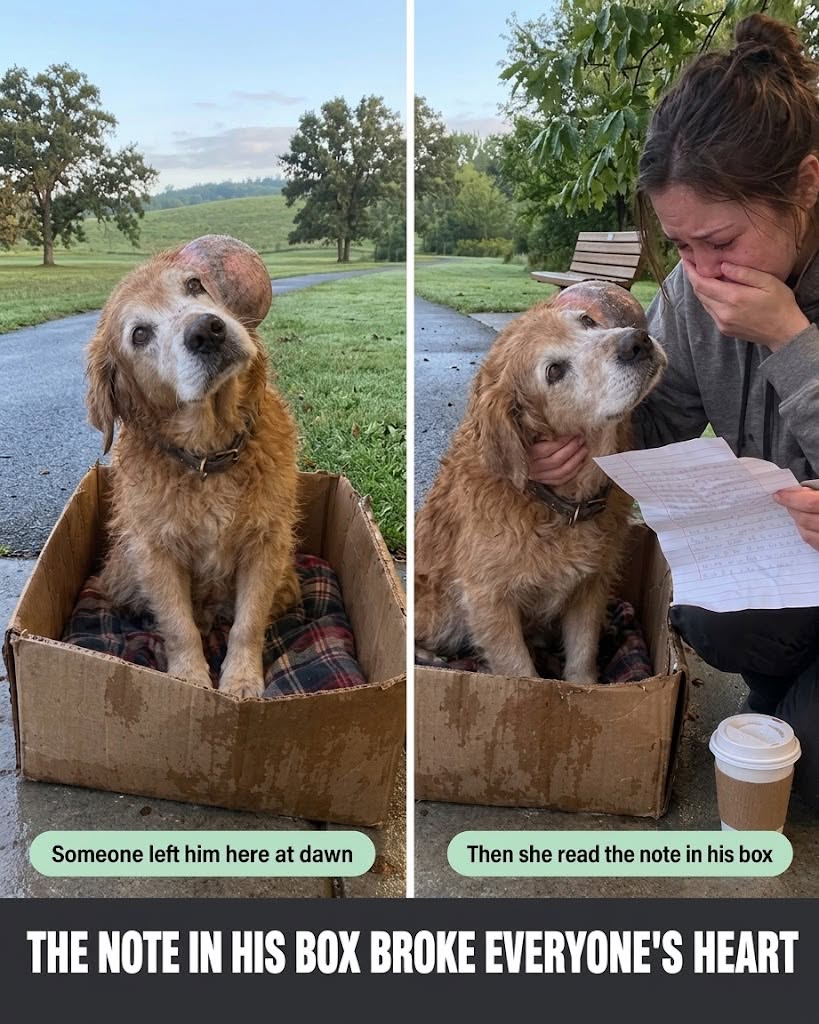
Buddy was sitting upright on the blanket she had given him, his head leaning to one side beneath the enormous weight of the tumor. He wasn’t lying down. He couldn’t settle on the painful side, and resting on the other seemed to make the lump pull uncomfortably. So he remained sitting, just as he had probably spent countless nights doing for years.
His eyes were fixed on the kennel door.
He was watching.
“Give me forty-eight hours,” Maya said.
Carol looked at her.
“Forty-eight hours,” Maya repeated. “Let me see what I can do.”
Carol remained silent for a long moment before finally sighing.
“Forty-eight hours,” she agreed. “After that, I need an answer.”
That evening, a volunteer named Brianna Cole stayed behind after the shelter closed. Brianna was twenty years old, studying nursing at Virginia Western, and managing the shelter’s Facebook page in her spare time.
She sat cross-legged inside Kennel 7 beside Buddy and took a single photograph.
Just one.
It showed the elderly golden dog sitting awkwardly on a blue blanket, his white face tilted beneath the enormous growth on his head, his cloudy brown eyes looking directly into the camera. His expression was gentle and trusting.
Beside the photograph, she uploaded an image of the shaky handwritten note.
His name is Buddy. He is 11. He is a good boy. I do not have the money to get him fixed. Please don’t let him die alone.
Below the pictures, Brianna wrote:
Buddy was left at our door this morning inside a cardboard box. Someone cared enough to place him beneath our awning to keep him out of the rain and give him the shirt off their own back. Now we need to raise $7,800 to give him a chance at survival. We have just 48 hours. Please don’t let him die alone.
She published the post at 9:14 p.m. and went home.
When she woke up at 6 a.m., her phone was flooded with two hundred notifications.
By noon, the post had been shared 4,000 times. By midnight, that number had climbed to 30,000. A television station in Roanoke featured Buddy’s story, followed by another station in Richmond. Soon, a national morning show picked it up, too.
Donations began arriving in small amounts. Five dollars. Ten dollars. Twenty.
A retired schoolteacher in Ohio sent fifty dollars with a message: For Buddy. My old dog had a lump, too. Nobody helped us.
A little girl in Texas contributed two dollars and thirty-one cents from her piggy bank. A truck driver in Montana donated one hundred dollars.
At 9:02 p.m. on the second night, forty-seven hours and forty-eight minutes after Brianna had published the post, Maya refreshed the fundraising page for what felt like the hundredth time.
Then she burst into tears.
The total had reached $8,412, contributed by 3,106 people.
Carol Bennett walked over to Kennel 7 and personally removed the red tag from the door.
“All right,” she said, her voice trembling slightly. “All right. Let’s get him better.”
Buddy sat on his blanket, still watching the door.
The CT scan and biopsy were scheduled for the following morning at the specialty hospital in Blacksburg. Dr. Whitfield drove Buddy there himself.
Everyone at the shelter understood how much depended on the biopsy results. If the growth proved cancerous or had spread into the bone, all that money and kindness might only give Buddy a few additional months. Perhaps even less.
At 3:47 that afternoon, Dr. Whitfield called the shelter.
Maya answered the phone and immediately noticed something unusual in his voice.
“Put me on speaker,” he requested. “Everyone needs to hear this.”
Part 3: Six Years
The entire staff gathered around the phone at the front desk. Kev, Diane, Brianna, Carol, and Maya stood together, holding their breath.
“The tumor is benign,” Dr. Whitfield announced.
For a moment, nobody seemed to understand what he had said.
“It isn’t cancer,” he repeated, his voice cracking with emotion. “It’s a lipoma, a fatty tumor. In twenty-two years of practice, I’ve never seen one this large. It’s sitting on top of the skull, beneath the muscle, but it isn’t attached to the bone. It hasn’t invaded anything. It’s simply… fat. An enormous mass of fat that has been growing for years.”
The front office erupted in celebration. Diane began crying. Kev tossed his cap into the air. Brianna grabbed Maya and hugged her so tightly that they nearly lost their balance.
“How long has it been growing?” Carol asked once the excitement settled. “Can you tell?”
“Judging by its size and the way it has displaced the surrounding muscle, I’d estimate six years,” Dr. Whitfield replied. “Possibly longer.”
Silence returned to the room.
“Six years,” Carol murmured. “And nobody ever took him to a veterinarian.”
“When a lipoma like this is still marble-sized, removing it is a twenty-minute procedure,” Dr. Whitfield explained quietly. “It would cost two or three hundred dollars.” He paused. “But that never happened. The growth was left alone, and it continued getting bigger.”
The anger that had briefly faded came rushing back. Maya could feel it spreading through the room.
Six years.
Someone had watched the lump grow from the size of a marble to a golf ball, then a baseball, and eventually a grapefruit.
And they had done nothing.
Then they had abandoned him in a box.
“They said they couldn’t afford it,” Maya whispered.
Nobody answered.
Two days later, a surgeon at the specialty hospital in Blacksburg removed the tumor during a three-hour operation.
It weighed four pounds and six ounces. The medical team placed it on a scale and photographed it.
When Buddy woke from anesthesia, he was groggy and disoriented. A long, neat row of stitches ran down the left side of his head, where the surrounding fur had been shaved away.
For the first time in six years, his head rested straight on his neck.
That evening, after Buddy returned to the shelter, Maya sat beside him inside Kennel 7.
Buddy slowly turned around on his blanket, as dogs often do before settling down. Then, with great care, as though he wasn’t certain he was allowed to, he lowered himself onto the bedding.
He lay on his left side.
All four legs stretched outward. His newly lightened head rested against the blanket. A long, deep, trembling sigh escaped him, seeming to rise from somewhere deep inside his tired old body.
Then he fell asleep.
Maya remained beside him, silently crying as he slept, his paws twitching while he dreamed.
From the doorway, Brianna whispered, “Look at him. He’s lying down. He’s actually lying down.”
Everyone believed that was the end of Buddy’s story.
But the following morning, Maya arrived at 6:52 again, only to discover that Buddy was missing from his kennel.
For one frightening moment, she thought he had somehow escaped.
Then she spotted him.
He was sitting in the front lobby beside the glass entrance, precisely where his cardboard box had been left. His body was upright, his front paws placed together, his back straight. Beyond the glass, he stared out at the fog-covered parking lot.
Toward the road.
Waiting.
Kev had taken Buddy out of his kennel for a little morning stretch. The old dog had walked directly to the entrance and settled into that exact spot.
He repeated the same routine the next morning.
And the morning after that.
Every day, as soon as someone opened his kennel, Buddy slowly made his way down the hallway, sat beside the front door with his head now straight and clean, and watched the road.
He never barked.
He never whined.
He simply watched.
Whenever a car entered the parking lot, he lifted his head hopefully. Each time, it turned out to be someone else. Each time, he lowered his head again.
“He’s waiting for somebody,” Brianna whispered on the fifth morning.
“Who?” Kev asked. “The guy who abandoned him?”
But no one laughed.
Maya stood in the lobby, studying the old dog’s back. She thought about the soft plaid flannel shirt carefully folded beneath him inside that wet cardboard box. She remembered the unsteady handwriting of an elderly man.
Please don’t let him die alone.
What kind of person could write those words and then walk away?
Part 4: The Handwriting
The answer arrived from someone Maya had never met.
On the sixth day, at 2:13 in the morning, a woman named Grace Mensah sent a private message to the shelter’s Facebook page.
Hi. I’m a night nurse at Mercy Ridge Hospice House in Salem. I saw Buddy’s story on the news. I don’t want to get anybody in trouble. But I think I know that handwriting.
As soon as Brianna woke up, she showed Maya the message. Maya immediately called the phone number Grace had provided.
Grace answered on the first ring, as though she had been expecting the call.
“I’m sorry for reaching out so late,” Grace explained. Her voice was gentle, carrying a warm West African accent. “I work nights, and I haven’t been able to stop thinking about the story.”
“You recognized the handwriting?” Maya asked.
“Our patients fill out little meal cards telling us what they’d like to eat the following day,” Grace said. “For three weeks, I’ve been reading the cards from one particular patient. His handwriting is always shaky. He forms his capital B in the same unusual way.” She paused. “And he keeps saying the same thing to me every single night.”
“What does he say?”
Grace fell silent for a long moment.
“He asks whether anyone has saved his dog.”
Maya dropped onto the edge of her bed.
“His name is Arthur Pell,” Grace continued. “He’s eighty-four and suffers from congestive heart failure. He arrived here three weeks ago, and his doctors estimated he might have only a few weeks left.” Her voice wavered. “An ambulance brought him to us. But the night before, his neighbor saw him board a city bus at the Melrose Avenue stop around midnight. He was wearing his robe and slippers and carrying a cardboard box.”
Maya covered her mouth with her hand.
Mercy Ridge Hospice House was only six miles from the shelter.
That afternoon, Maya and Carol drove to Salem.
Mercy Ridge was a modest brick building on a hill. Rocking chairs lined its porch, and a garden filled with late-blooming chrysanthemums surrounded the property.
Grace met them at the entrance. Tall and dressed in navy scrubs, she had kind, gentle eyes. She led them down a peaceful hallway to Room 14.
Arthur Pell lay propped up in bed beside a window, an oxygen tube resting beneath his nose. He was painfully thin, with wisps of white hair and large, knobby hands folded over his blanket.
On the nightstand sat a framed photograph of a smiling woman standing in a garden, holding a young golden retriever puppy in her arms.
When Arthur noticed the two unfamiliar women standing in the doorway beside his nurse, he lifted his head.
“Mr. Pell,” Grace said softly, “these ladies are from the animal rescue shelter in Roanoke.”
The old man’s entire body stiffened.
“Is he…” he began in a dry whisper, unable to finish the question.
“He’s alive,” Maya said quickly, moving to his bedside. “Mr. Pell, Buddy is alive. He had surgery five days ago. The tumor wasn’t cancerous. It’s been removed, and he’s doing well.”
Arthur stared at her.
Then his face crumpled, and he began to cry. He made no sound. Tears rolled down his sunken cheeks and past the oxygen tube as his thin shoulders trembled.
“Someone saved him,” he whispered. “Someone saved him.”
Carol pulled a chair beside his bed.
“Mr. Pell, would you tell us what happened?”
The story came slowly. Arthur needed to pause between sentences to rest.
Buddy had belonged to his wife, June. Eleven years earlier, she had chosen him as a puppy from a farm in Bedford County. She named him Buddy because he followed her everywhere in the garden, like her closest companion.
Then June became ill.
First came the dementia. At first, it progressed slowly. Then everything deteriorated quickly.
“I spent everything I had,” Arthur whispered. “Every last penny went toward her nursing care and medication. We sold the car, then her jewelry. I worked as a school janitor for thirty-eight years. We never had much money.”
He swallowed before continuing.
“The lump on Buddy’s head was tiny when it first appeared. I kept telling myself, next month. Next month, I’ll have enough money to take him to the vet. Next month.”
His eyes moved toward the framed photograph on the nightstand.
“June died two years ago. By then, the lump had grown enormous. I was sick myself, and there was never enough money.” His voice broke. “I watched it get bigger every day. I would sit on the porch with him and hold his head in my lap so the weight wouldn’t hurt his neck. I failed him. For six years, I failed him every single day.”
By then, Maya was crying, too.
“Three weeks ago, my doctor told me my heart was failing,” Arthur continued. “He said I would need hospice care. And I started thinking about Buddy. What would happen if I died one night in that empty house? He would be lying beside me with that terrible lump on his head, and nobody would come for days. He might die, too. All alone.”
He raised his tear-filled blue eyes toward Maya.
“So I put him in a box,” he said. “I gave him my shirt so he would have my scent. I took the midnight bus because I didn’t want anyone to see me. I placed him beneath the awning where he would stay dry. Then I sat in the bus shelter across the street, in the darkness, until I saw a light come on inside.”
“You stayed there watching?” Maya whispered.
“I couldn’t leave until I knew someone would open the door.” Arthur closed his eyes. “After that, I went home. The ambulance came the next morning.”
Grace stood in the doorway, tears running down her face.
“Every night,” she said quietly. “Every night since he arrived, he asks me the same question when I come into his room. ‘Did anyone save him?’ And every night, I’ve had to tell him, ‘I don’t know, Arthur. I really don’t know.’”
Arthur reached out with a trembling hand and gently took Maya’s hand in his.
“Can I see him?” he whispered. “Just once, before I go?”
Maya looked toward Carol.
Carol turned to Grace.
Grace’s expression fell.
Part 5: Not Yet
“I can’t make that decision myself,” Grace explained quietly in the hallway outside Room 14. “Mercy Ridge has strict policies. Any animal entering a patient’s room must either be a certified therapy dog or the patient’s own pet, with current vaccination records and veterinary clearance.”
“Buddy is his own dog,” Maya replied.
“I understand that. But he underwent major surgery only five days ago,” Grace said. “He still has an open incision on his head. Our medical director takes infection prevention very seriously. Some of our patients are receiving chemotherapy and have almost no immune defenses.” She shook her head. “She’ll insist that he be completely healed, with his sutures removed and your veterinarian’s clearance.”
“How long will that take?” Carol asked.
“For an incision that large?” Maya said thoughtfully. “Dr. Whitfield told us fourteen days. At least.”
The three women stood silently in the hallway, each thinking the same terrible thought.
Arthur Pell might not have fourteen days left.
That evening, Maya returned to the shelter and sat with Buddy inside Kennel 7 until midnight.
“Your Arthur is alive,” she told him, gently stroking his straight, clean head. “He’s only six miles away. He’s been asking about you every single night.”
Buddy thumped his tail against the blanket.
The next morning, at 6:52, he was back at the entrance, staring down the road.
Maya went to see Dr. Whitfield.
“Please,” she begged. “Is there any way you could remove his stitches a little earlier?”
Dr. Whitfield carefully examined the long incision running along Buddy’s head. He remained quiet for a considerable time.
“The wound is healing beautifully,” he finally said. “But if I remove the stitches too soon and the incision opens, he could develop an infection that might kill him. Considering his age and everything he’s been through during surgery…” He shook his head. “Ten days. That is the absolute earliest I can approve his clearance. I’m sorry.”
Ten days.
Every evening, Maya called Grace.
“He’s exhausted today. He spent most of the afternoon sleeping.”
“He asked about Buddy again. I told him Buddy was recovering.”
“He refused his dinner tonight. I managed to get him to drink some juice.”
On the seventh day, Brianna visited Mercy Ridge carrying her phone. She showed Arthur a video of Buddy stretched out on his left side, sleeping peacefully on his blanket, his paws twitching as he dreamed.
Grace later told Maya that Arthur watched the video eleven times. He held the phone against his chest and eventually fell asleep with it pressed there.
On the eighth day, Grace called Maya in the middle of the afternoon.
That had never happened before. Until then, Grace had always called at night.
“Maya,” she said, her voice noticeably different. “His breathing changed this morning. The doctor has examined him. They’ve moved him to comfort care.”
Maya felt her heart stop.
“What does that mean?”
“It means we’re no longer trying to treat his failing heart,” Grace explained gently. “Our focus is keeping him comfortable now.” She paused. “He might have a few days left. Or it could happen tonight.”
Maya struggled to breathe.
“He keeps asking for Buddy,” Grace whispered. “He isn’t making much sense anymore, but he keeps repeating his name.”
Maya ended the call and rushed to Dr. Whitfield’s office.
“It’s the eighth day,” she said through her tears. “Please.”
Dr. Whitfield looked at her for a long moment.
“Maya, I’m a veterinarian,” he said quietly. “My responsibility is to protect Buddy. If that incision comes apart…”
“I know,” Maya interrupted, crying openly now. “I know. But every morning, he walks to that front door and watches the road. He’s been doing it for eight days. He’s waiting for Arthur, and Arthur is waiting for him. They’re only six miles apart.”
Her voice broke.
“Arthur placed Buddy in that box at midnight because he was terrified his dog would die alone. And now Arthur is going to die alone.”
Dr. Whitfield said nothing.
At 9:40 that night, Grace called again.
Maya was sitting on the floor inside Kennel 7, Buddy’s head resting in her lap.
“Maya,” Grace whispered, “the doctor just spoke to me. If there’s someone Arthur needs to see, it should happen tonight. I don’t believe he’ll survive until morning.”
Part 6: Room 14
Dr. Whitfield was standing in the doorway of the kennel room, still wearing his coat.
He had heard everything.
He walked over to Kennel 7, knelt beside Buddy, and examined the incision on the dog’s head using the flashlight on his phone. Then he opened his medical bag on the concrete floor.
“Hold his head steady,” he quietly instructed Maya.
He removed Buddy’s sutures himself.
Two days earlier than planned.
He worked slowly and carefully, taking out each stitch one by one. When he finished, he covered the healing incision with a clean, soft surgical dressing and secured it gently in place.
“I’ll sign the clearance,” he said, his voice rough with emotion. “If their medical director has any concerns, she can call me directly.”
He stood.
“Go,” he told her.
Maya drove the car. Carol sat in the passenger seat, while Brianna rode in the back with Buddy resting across her lap. His newly bandaged head lay against her knee.
They traveled the six miles to Salem, following Melrose Avenue and passing the bus stop where an elderly man had stood at midnight carrying a cardboard box. Then they drove up the hill toward Mercy Ridge.
Grace was waiting at the hospice entrance, dressed in her navy scrubs. She had received permission from the doctor on call.
She didn’t say anything.
She simply opened the door for them.
They made their way down the dim, silent hallway. Maya held Buddy’s leash as he walked slowly beside her, his nails clicking softly against the floor while he sniffed the air.
Halfway down the corridor, Buddy stopped.
His nose lifted.
His ears perked up.
His entire body became still.
Then his tail began to wag.
He pulled gently against the leash at first, then with increasing determination.
Maya released him.
The eleven-year-old dog, stiff in his hips but suddenly filled with purpose, trotted the remaining distance down the hallway by himself. He went straight to the doorway of Room 14 and paused there for one long second.
Arthur Pell lay in the bed beside the window. His eyes were closed, his breathing shallow and slow, the oxygen tube resting beneath his nose.
Buddy didn’t hesitate.
He crossed the room and climbed onto the bed, moving carefully and gently, the way an old dog does when he understands that someone he loves is fragile.
He stepped over the tubes, settled alongside Arthur’s body, and pressed his straight, clean head against the old man’s chest.
A long, quiet whine escaped him.
Arthur opened his eyes.
He looked down at the dog beside him. At the familiar white face. At the head that was no longer tilted. At the soft bandage covering the place where the grapefruit-sized tumor had once been.
Slowly, his thin hand lifted from the blanket and settled on Buddy’s head.
“Buddy,” he whispered. “Oh, Buddy. Look at you. Look at your head.”
Buddy reached up and licked his chin.
“Someone saved you,” Arthur whispered. “Someone saved you.”
Maya stood in the doorway, crying.
Grace was crying, too. So was Carol, who almost never shed a tear. Brianna covered her mouth with both hands.
They watched as the elderly man and his beloved dog held each other in the warm glow of the bedside lamp.
“Everyone told me I wouldn’t live until morning,” Arthur whispered after a long silence, his voice sounding slightly stronger. “I thought tonight would be the night. I was ready to go.”
He gently stroked Buddy’s ear.
“I just couldn’t leave without knowing.”
He turned his head on the pillow and looked at Maya.
“I thought I was saving him,” Arthur said. “I brought him to you so he wouldn’t die alone in that house with me.”
His gaze returned to the dog resting against his chest.
“But I was the one dying alone,” he whispered. “And he came back for me.”
Arthur Pell did not die that night.
He survived the following night, too.
The doctors couldn’t explain the change. His breathing became steadier. His heart, which had seemed close to giving out, continued beating.
On the third morning, he asked Grace to bring him scrambled eggs.
“I’ve witnessed this before,” the hospice doctor quietly told Maya in the hallway. “Not very often, but it happens. Sometimes people are holding on for something. And sometimes, once they finally get what they need, they choose to hold on a little longer.”
The following day, the medical director at Mercy Ridge came to visit Room 14 herself.
She looked at Arthur sleeping peacefully with one arm wrapped around the golden dog.
She didn’t mention the rules even once.
Part 7: The Door
Arthur Pell lived for another five weeks.
Buddy stayed by his side the entire time.
Every day, he lay on the bed beside Arthur, resting his head against the old man’s chest and rising and falling with each breath. Grace brought a dog bed from her own home and placed it on the floor beside the window, but Buddy used it only when Arthur asked him to.
Together, they watched the leaves fall in the garden.
Arthur told Buddy stories about June, about the farm in Bedford County where they had chosen him, and about the garden she had once lovingly tended. He remembered her tomatoes and zinnias, and how their golden puppy had delighted in digging them all up.
Grace spent her breaks sitting with them.
Brianna visited every Saturday.
Maya came each evening after finishing work.
Then, on a cold and peaceful night in early December, at 2:20 in the morning, Arthur Pell passed away in his sleep with his hand resting on Buddy’s head.
Grace was there.
She later explained that Buddy didn’t move for an entire hour after Arthur died. He lay perfectly still, his head against the old man’s chest, as though he were listening for a familiar heartbeat.
Eventually, he climbed down from the bed, walked over to Grace, and leaned against her legs.
Two weeks later, Grace Mensah adopted Buddy.
She had worked night shifts at Mercy Ridge for eleven years and lived alone. Until then, she had never owned a dog.
“He chose me,” she said simply. “On that final night, he came to me. I’m not going to argue with him.”
In January, Mercy Ridge Hospice House welcomed Buddy as its first official therapy dog.
Grace brought him to work during every night shift. He wore a small blue vest bearing the words THERAPY DOG and a new brass tag attached to his old, cracked leather collar—the same collar Arthur and June had bought for him eleven years earlier.
The tag read:
BUDDY. Nobody here dies alone.
Every night, Buddy walks through the quiet hallways of Mercy Ridge alongside Grace. He visits every room, climbs onto the beds of patients who welcome him, and lies beside them with his white face resting against their chests.
And every morning, when her shift ends at 6:52, Grace finds him in the same place.
He sits beside the hospice’s glass entrance, upright with his front paws together and his back straight, watching the parking lot as patients’ families begin arriving, one vehicle at a time.
Once, an elderly dog waited outside a door in a cardboard box, hoping someone would come to save him.
Now he waits inside the door, ready for whoever might need him next.
Grace keeps Arthur’s final meal card in her locker. It was the card he completed on the morning before he died.
Under the question, What would you like for breakfast tomorrow?, he had written in shaky, trembling letters:
Scrambled eggs. And a little bacon for Buddy.
Beneath those words, in handwriting so faint she could barely make it out, was another message:
He took the bus at midnight to leave his dog at our door, because he didn’t want him to die with him in an empty house. All he wanted to know before he left was one thing. Did anyone save him?
Grace wrote that final part herself. She simply never wants to forget the answer.
Somebody did.