I looked up slowly.
Behind him stood two younger soldiers, both trying very hard not to laugh.
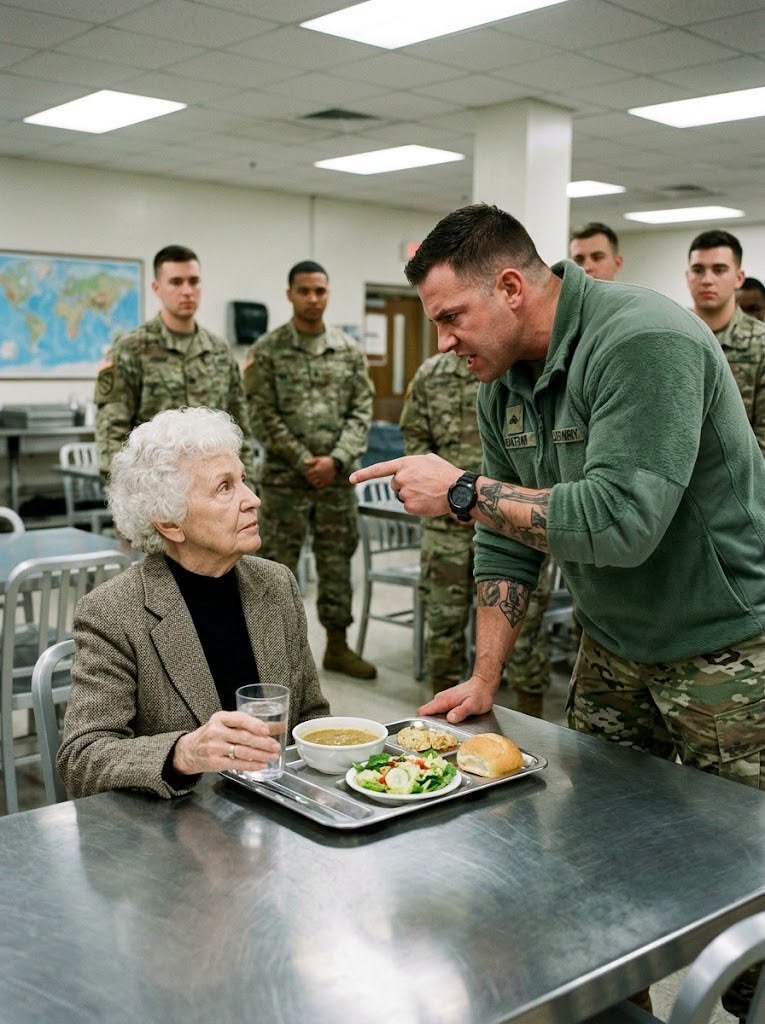
I was seventy-two years old, wearing an old Army sweatshirt, faded jeans, and the same pair of boots I’d owned for nearly fifteen years. My gray hair was tied back, and my hands were wrapped around a cup of coffee.
Apparently, that was enough for Staff Sergeant Reese to decide I was somebody he could embarrass.
“What’s the matter?” he continued. “Did they stop making your rank before I was born?”
One of the other soldiers chuckled.
I put my spoon down.
“Son, I’m trying to eat my lunch.”
“Then answer the question. Were you even in the military?”
I looked at the three of them.
“Yes.”
Reese smiled.
“What rank?”
“Master Sergeant.”
His smile widened.
“Sure you were.”
I reached for my coffee.
“United States Army. Twenty-six years.”
The two soldiers exchanged glances. Reese folded his arms.
“Twenty-six years? Doing what? Typing paperwork?”
I almost laughed.
“No. I was an Army medic. Then I spent the final twelve years of my career working with military casualty evacuation teams.”
His expression changed slightly, but he recovered quickly.
“Well, things were different back then, Grandma.”
I nodded.
“They certainly were.”
He leaned closer.
“So what was your biggest accomplishment? Making coffee for a general?”
I looked directly at him.
“Getting thirty-seven soldiers out of a burning transport vehicle in Afghanistan.”
The restaurant suddenly seemed quieter.
One of the younger soldiers stopped smiling.
Reese shifted his weight.
“Afghanistan?”
“Yes. During an evacuation operation. We took fire, the vehicle caught fire, and the road behind us was blocked. I was responsible for getting the wounded out and keeping them alive until evacuation arrived.”
I took another sip of coffee.
“Some of those boys were younger than you.”
Nobody laughed this time.
Reese glanced at the name tape on my sweatshirt.
It was an old unit patch, faded from years of washing.
“Where did you serve before that?” he asked.
“Germany. Korea. Iraq. Afghanistan. A few places I don’t discuss over lunch.”
One of the younger soldiers finally spoke.
“Ma’am, what unit were you with?”
I told him.
His eyes widened.
He looked at Reese, then back at me.
“Staff Sergeant, isn’t that the same unit our instructor mentioned during advanced medical training?”
Reese frowned.
“What?”
The young soldier pulled out his phone.
“Remember the case study about the female medic who stayed behind during the evacuation and treated wounded soldiers under fire? The one who received the Silver Star?”
I slowly put my spoon down.
I hadn’t thought about that day in years.
Reese stared at me.
“That was you?”
I shrugged.
“I was doing my job.”
The youngest soldier looked genuinely embarrassed.
“Ma’am, I’m sorry. I should have recognized your service.”
I gave him a small smile.
“You don’t have to recognize me, son. Just respect people until you know their story.”
Reese stood silently for several seconds.
Then he removed his patrol cap.
“Master Sergeant, I owe you an apology.”
I studied him.
“Yes, Staff Sergeant. You do.”
He nodded.
“I’m sorry for the way I spoke to you. That was disrespectful.”
I picked up my spoon again.
“Apology accepted. Now, if you boys don’t mind, my chili is getting cold.”
The youngest soldier smiled nervously.
“Would you mind if we bought your lunch, ma’am?”
I shook my head.
“Keep your money. Buy lunch for somebody who needs it.”
They started walking away.
But before Reese reached the door, I called after him.
“Staff Sergeant?”
He turned immediately.
“Yes, Master Sergeant?”
I pointed toward the two soldiers beside him.
“Teach those young men something important. Rank tells people what position you hold. It doesn’t tell them what kind of person you are.”
He nodded slowly.
“Yes, ma’am.”
Then all three gave me a proper salute.
I returned it.
When they left, the waitress approached my table.
“Ma’am, was that really you? The soldier from the story?”
I smiled and looked down at my chili.
“That was a long time ago.”
She glanced at my old boots.
“Why don’t you ever wear your medals?”
I thought about the men I had treated, the ones who came home, and the ones whose families received folded flags instead.
Then I answered quietly.
“Because the people who earned those memories with me aren’t all here to wear theirs.”
She didn’t say anything.
Neither did I.
I finished my chili, paid my bill, and walked out into the afternoon sunlight.
My knees hurt. My back hurt. And I still had forty minutes to drive home.
But as I reached my truck, I heard someone call out from behind me.
“Master Sergeant!”
It was Reese.
He had come back outside.
He stood straight, looked me in the eyes, and said something I will remember for the rest of my life.
“Thank you for serving, ma’am. And thank you for reminding me what wearing this uniform is supposed to mean.”
I nodded.
“Take care of your soldiers, Staff Sergeant. That’s the most important rank you’ll ever hold.”
And then I drove home.
Because after twenty-six years in uniform, I had learned something that no promotion, medal, or ceremony could ever teach:
You don’t measure a soldier by how loudly they demand respect. You measure them by how quietly they give it.