The Shift That Ended Too Quietly
For twenty-six years, Janet Holloway had poured her heart into St. Bridget Children’s Hospital in Louisville, Kentucky. To her, it was far more than just a workplace. It was where she had comforted frightened children during long nights, offered gentle reassurance to anxious parents, and taught younger nurses with patience and warmth. At fifty-six, she wasn’t the youngest on the pediatric floor, but she was the one families remembered most fondly.
Children adored the little blue stars on her shoes. Parents trusted her steady, calming presence. New staff members looked up to her because she always made them feel valued, never small for asking questions.
So when she was called into a private office on a rainy Monday afternoon, Janet assumed it was about routine scheduling matters.
Instead, she found Meredith Slane sitting behind the desk with a folder already prepared. The woman’s tone was cool and impersonal as she pointed to a chair.
“Janet,” Meredith began, “the hospital is going through some changes. Your position is being eliminated, effective immediately.”
Janet stared at her in disbelief. “Eliminated? I don’t understand. I’ve never had any major issues in all my time here.”
Meredith glanced briefly at the folder. “A complaint was filed with administration.”
Janet’s hands grew cold. “May I know what the complaint was about?”
Meredith offered a thin, professional smile. “That information is confidential.”
Janet sat up straighter. “If my work is being questioned, I believe I deserve an opportunity to respond.”
Meredith closed the folder. “You’re welcome to file a formal appeal, but you will not be allowed on hospital grounds during that time. I suggest you consider this carefully before proceeding.”
The message was clear: stay silent, accept it, and move on.
Less than fifteen minutes later, a quiet security guard escorted her to her locker. He was polite but avoided eye contact. Several nurses she had mentored looked away. One young colleague pressed a hand to her mouth, fighting back tears, but said nothing.
Janet packed her belongings into a cardboard box — a framed photo of her late mother, her trusted old stethoscope, and a collection of heartfelt thank-you cards from children who once called her “Miss Jan.”
By the time she reached her small silver car in the parking lot, the rain was falling heavily. She sat behind the wheel with both hands covering her face and let the tears come.
She had given more than half her life to that hospital. And in the end, it had let her go as though she had never truly mattered.
A Small Comfort She Could Hardly Afford
Janet knew she should drive home, but she couldn’t bring herself to start the engine. Her mind was overwhelmed, her car needed repairs, and the thought of returning to her quiet apartment in Shepherdsville felt unbearable. Instead, she left her car in the staff lot, walked through the rain, and took a rideshare to the bus station.
She hoped the long ride would give her space to breathe and gather her thoughts.
The station smelled of damp coats and weary travelers. Janet stood in line, clutching her cardboard box tightly to her chest. When she reached the counter, the clerk asked without looking up,
“One-way to Shepherdsville?”
“Yes, please,” Janet replied softly.
“Standard seat is forty-two dollars.”
She opened her wallet, then hesitated. Rent was due soon. Her savings were already thin. Groceries, gas, and basic needs weighed on her mind.
Then she noticed a small sign: Premium quiet seating — wider seats, more space, extra comfort. Two hundred thirty-nine dollars.
It felt foolish. Extravagant. Completely unlike her. For over two decades, she had always put others first.
But after being let go so coldly that day, she allowed herself one small moment of comfort.
The clerk raised an eyebrow. “Are you sure, ma’am?”
Janet looked down at the box in her arms and whispered,
“Just this once.”
When she boarded the bus, she found her seat — 1A, tucked behind a soft gray curtain. The chair was wide and comfortable, the window spotless. For the first time all day, the space felt peaceful.
She set her box gently at her feet, leaned back, and closed her eyes, finally allowing herself a quiet breath.
The Man In The Aisle
The calm didn’t last long.
Janet was stirred by the sound of voices. The driver was trying to remain patient, while a passenger responded in a strained, low tone. Other travelers shifted uncomfortably in their seats, pretending not to watch but clearly paying attention.
She pulled back the soft curtain and looked toward the front.
A tall, broad-shouldered man in a black leather vest was struggling to fit into one of the narrow regular seats. He appeared to be in his late forties, with short dark hair and a beard lightly streaked with gray. His movements were slow and cautious, as if every shift caused discomfort. Visible scars ran along one side of his neck and arm — silent evidence of a difficult past.
The driver stood beside him, hand on the seat back.
“Sir, I need you properly seated before we can depart.”
The man gripped the armrest tightly. “I’m doing my best.”
“If the seatbelt doesn’t fit safely, I can’t allow you to travel like this,” the driver said.
The man’s face showed not anger, but quiet embarrassment.
Janet recognized that expression all too well. She had seen it in young patients after painful procedures, in worried parents, and in her own mirror earlier that day.
Without overthinking it, she stepped out from her seat.
“Excuse me,” she said gently. “I’m a nurse. Would it be alright if I helped?”
The man glanced at her, his eyes cautious. “I’m fine, ma’am.”
Janet stayed at a respectful distance. “I believe you, but that seat looks quite uncomfortable for someone your size.”
He looked away. “I bought my ticket. I’ll manage.”
The driver sighed. “Sir…”
Janet turned to the driver. “Could he take my seat instead?”
The driver blinked in surprise. “Your premium seat?”
“Yes,” Janet said without hesitation.
The man immediately shook his head. “No. I’m not taking your seat.”
“You’re not taking it,” Janet replied softly. “I’m offering it freely.”
His jaw tightened. “I don’t want anyone’s pity.”
“This isn’t pity,” she said. “I had one of the worst days of my life, and I really need to do one good thing before I go home and feel sorry for myself.”
The entire bus fell quiet.
The man studied her for a long moment. Then he accepted the ticket with both hands.
“My name is Owen,” he said quietly. “Owen Maddox.”
“Janet Holloway.”
He nodded. “Janet… I won’t forget this.”
The Card In Her Purse
Janet helped Owen get comfortable in the wider premium seat. She adjusted the backrest carefully so his shoulder wouldn’t strain and placed his small bag within easy reach.
For the first time, the tight lines in his face began to soften.
“Thank you,” he murmured.
“You’re very welcome,” Janet replied with a gentle smile.
Before she returned to the regular seating area, Owen reached into his vest pocket and pulled out a worn black card. On the front was a silver emblem with wings and the words “Iron Harbor Riders.” He wrote something on the back with slow, deliberate movements.
He handed it to her.
“Keep this with you.”
Janet looked at the card. “What is it?”
“A promise,” Owen said. “If you ever need anything, call that number.”
She tried to return it. “Owen, I didn’t do this expecting anything in return.”
He met her eyes with quiet sincerity. “That’s exactly why it matters.”
Janet didn’t know how to respond.
Owen gazed out the window for a moment before speaking again, more softly this time.
“A few years back, something happened that left me scarred and changed how the world sees me. People stare. Some on purpose, some without meaning to. After a while, you start feeling like you’re a problem everywhere you go.”
Janet felt a lump form in her throat.
“Today,” he continued, “you made me feel human again.”
She closed her fingers around the card.
“I’m just a nurse,” she said humbly.
Owen shook his head.
“No. You’re someone who still chooses to stop when another person is hurting.”
Janet returned to her new seat in the middle of the bus. It was smaller, the armrest was wobbly, and a child behind her occasionally kicked the seat. But she felt no regret.
She slipped Owen’s card safely into her purse, next to her empty wallet and old hospital badge, holding onto it like a small reminder that the day had not taken away her ability to care.
The Call That Came The Next Morning
Janet woke at 5:40 the following morning, as she had for most of her adult life. For a brief moment, she reached instinctively for her scrubs before the reality settled in. There was no early shift waiting for her. No little patients needing her gentle care. No reason to rush into the day.
She sat on the edge of her bed, letting the heavy silence wrap around her.
By nine o’clock, she had submitted applications for four different positions. By ten, two had already requested references. Then, at eleven, a message arrived from a former colleague:
“I’m so sorry, Jan. They told everyone not to speak with you for now.”
Janet read the message twice, then set her phone down gently. It felt as though her entire career had been placed in someone else’s hands, and those hands were determined to push her aside.
Then her phone rang.
Unknown number.
She nearly let it go to voicemail, but it rang again. And again.
Finally, she answered.
“Hello?”
A calm, deep voice spoke on the other end.
“Is this Janet Holloway?”
“Yes, it is.”
“My name is Sawyer Bennett. I ride with Owen Maddox. He told us about what you did for him on the bus yesterday.”
Janet closed her eyes. “It was really nothing — just a seat.”
There was a thoughtful pause.
“It was much more than that to him.”
Janet slowly sat down at her kitchen table.
Sawyer continued gently, “Owen doesn’t ask for help often. When he called us last night, he said a kind woman reminded him that he still matters. That means a great deal to our group.”
Janet pressed a hand to her chest, unsure how to respond.
“You don’t need to say anything,” Sawyer added. “But if you’re comfortable, we’d like to meet you today. There’s a quiet diner on Maple Street. We promise to be respectful.”
Janet glanced around her small apartment — at the pile of bills on the table and the cardboard box still waiting by the door.
She almost declined.
Then she remembered the look in Owen’s eyes when he accepted the ticket.
“All right,” she said softly. “Noon would work.”
“Thank you, Janet,” Sawyer replied. “We’ll see you then.”
The Diner Full of Leather Vests
Maple Street Diner was a cozy place with red vinyl booths, faded photographs on the walls, and coffee strong enough to steady anyone’s nerves.
Janet arrived a little early and chose a booth by the window.
At exactly 11:58, the low rumble of engines filled the street. Customers turned their heads as twelve motorcycles pulled into the parking lot in an orderly line.
The riders dismounted with quiet dignity. They were mostly large, strong-looking men and a few women, all wearing leather vests, but they carried themselves with calm respect rather than loud bravado.
A tall man with silver hair and warm eyes entered first. He removed his sunglasses and approached her table.
“Janet Holloway?”
She nodded.
“I’m Sawyer Bennett.”
He sat across from her, leaving plenty of respectful space between them.
“Thank you for agreeing to meet with us.”
Janet glanced at the group outside. “I wasn’t expecting quite so many of you.”
Sawyer offered a small, friendly smile. “This is us trying to be low-key.”
Janet surprised herself by letting out a soft laugh.
Sawyer leaned forward slightly, his voice kind.
“Owen is like family to us. He’s been through a lot, and some days it’s still hard for him to feel like he belongs in everyday spaces. What you did yesterday gave him back a piece of that belonging.”
Janet looked down at her coffee cup.
“I didn’t think it was anything special.”
“That’s what makes good people special,” Sawyer said quietly. “They rarely see it themselves.”
Her eyes began to fill with tears. Sawyer waited patiently without rushing her.
After a moment, he asked gently, “What happened to you yesterday?”
The simple question unlocked something inside her. Janet found herself telling him everything — the sudden meeting, the cold dismissal, the warnings, the way her colleagues had looked away, and the deep fear that her years of service might now count for nothing.
When she finished, her napkin was tightly twisted in her hands.
Sawyer’s expression had grown thoughtful and focused.
“Be home tomorrow morning at eight,” he said.
Janet blinked in surprise. “Why?”
Sawyer stood up slowly.
“Because kindness like yours should never go unanswered.”
Ninety Riders On A Quiet Street
The next morning, Janet stood by her front window, peering through the curtain well before eight o’clock. She tried not to get her hopes up. Perhaps Sawyer would bring a few groceries or mention a job lead. Or perhaps nothing would happen at all.
At 7:57, the sound started — a deep, growing rumble that filled the air.
Janet stepped onto her porch just as motorcycle after motorcycle turned onto her peaceful residential street. One by one, they arrived until the entire road was lined with shining chrome, black leather, and morning sunlight.
Neighbors stepped outside. Dogs barked curiously. Curtains parted in windows up and down the block.
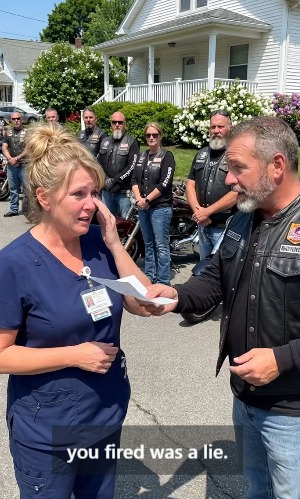
Ninety riders parked in neat, respectful rows in front of her small duplex. No one revved their engines loudly. No one made a spectacle. They simply showed up.
Sawyer stepped forward, holding a folder.
“Janet Holloway,” he announced clearly so the whole street could hear, “we’re here to return the kindness you showed our brother.”
Janet stood frozen, one hand on the porch railing.
“I… I don’t understand.”
A woman named Brooke moved to Sawyer’s side.
“Some of us work in finance, others in law and hospital administration. We know how to look into things.”
Sawyer lifted the folder.
“The complaint made against you was not truthful.”
Janet felt her knees weaken.
Brooke continued gently, “Records show that support funds for the children were being mishandled. You were removed because you asked the right questions and because families trusted you deeply.”
Janet covered her mouth with trembling hands.
Sawyer’s voice softened. “The hospital board has been informed. Local authorities are now involved. Meredith Slane is no longer in charge of those decisions.”
Janet slowly sat down on the porch steps, overwhelmed. Tears came freely — not the heavy, hopeless ones from the day before, but tears of deep relief and disbelief that she had not been forgotten after all.
Sawyer handed her an envelope.
“Your rent is taken care of for the next six months.”
Another rider stepped forward. “Your car repairs are covered.”
Then another. “Utilities and insurance are current.”
Janet shook her head through her tears. “I can’t accept all of this.”
Sawyer crouched down gently so their eyes were level.
“You can,” he said warmly. “Because you gave Owen something precious when it cost you personally.”
Finally, he handed her one last envelope.
“This one is from Owen himself.”
Inside was a handwritten note. Janet read it with shaking fingers.
Owen wrote that he had spent years feeling invisible, seen only for his scars. He said one nurse on a bus had reminded him what it felt like to be treated with simple human dignity. He wanted her to know she was not alone.
At the bottom, he had written:
“You gave me a seat, Janet. Let us give you solid ground to stand on.”
One by one, the riders quietly placed white roses along her porch steps — ninety roses in total — each one a silent symbol of gratitude and solidarity.
Walking Back With Her Head High
Three days later, Janet received a call from St. Bridget Children’s Hospital. This time it wasn’t Meredith. It was the hospital director.
His voice was serious and regretful.
“Mrs. Holloway, we owe you a sincere apology.”
Janet listened quietly as he continued.
“You were treated unjustly. Your record has been fully restored. We would like to offer you the position of Director of Pediatric Family Care, along with back pay and a public correction.”
Janet closed her eyes for a moment, remembering the rain, the cardboard box, and the heavy weight she had carried.
Then she remembered the roses on her porch.
She opened her eyes.
“I will return,” she said, “but only if the staff who felt afraid to speak are protected, and the families who needed those support funds finally receive them.”
There was a brief pause.
“Agreed,” the director replied.
When Janet walked back into the hospital the following Monday, she wore fresh navy scrubs and her beloved blue-star shoes. The lobby was filled with people. Nurses lined the entrance. Parents held flowers. A little boy in a wheelchair waved excitedly when he saw her.
The hospital director stepped forward and spoke publicly.
“Janet Holloway, this hospital failed you. Today we correct that wrong and welcome you back with the respect and gratitude you have always deserved.”
Warm applause filled the space.
Janet didn’t feel triumphant in a loud way. She felt steady, grateful, and whole again — as though a piece of her life that had been taken had finally been returned.
From down the pediatric hallway, a little girl’s voice called out joyfully, “Miss Jan! You came back!”
Janet walked over, knelt down, and took the child’s small hand in hers.
“Yes, sweetheart,” she whispered with a gentle smile. “I came back.”
The Fund That Began With One Seat
That evening, Janet sat quietly at her kitchen table, turning Owen’s card over in her hands.
Her phone rang.
It was him.
“Janet?” His voice was deep and familiar.
She smiled through fresh tears. “Owen.”
“I heard you got your position back,” he said.
“I did,” she replied warmly. “And I also heard that your friends don’t take no for an answer very easily.”
Owen let out a soft chuckle. “They have good intentions.”
Janet glanced toward the porch, where the white roses still stood in jars and cups — she couldn’t bring herself to part with any of them.
“They didn’t just help me,” she said. “They saved me.”
Owen was silent for a moment.
“No,” he replied gently. “You reminded all of us what real help looks like.”
They spoke for nearly an hour — about recovery, about work, about quiet homes, and about the power of unexpected kindness. They talked about how people often need support most when they’re trying hardest to appear okay.
Then Owen said, “I keep thinking about families traveling long distances for medical care. People who need extra space, comfort, and dignity on the journey.”
Janet sat up a little straighter.
“A travel support fund,” she said.
“That’s exactly what I was thinking,” Owen replied.
Janet smiled. “Then let’s make it happen.”
Six months later, the Holloway-Maddox Dignity Fund helped its first patient travel comfortably to treatment.
Janet stood outside the hospital and watched the specially arranged transport pull away. Owen stood beside her, hands in his vest pockets.
“All of this started with one bus seat,” he said quietly.
Janet turned to him.
“No,” she replied softly. “It started with choosing not to look away.”
Owen nodded, a peaceful expression on his face.
For the first time in years, both of them felt hopeful that the road ahead still held gentle things.
Reflections
If life has ever made you feel invisible or replaceable, remember this: titles can be taken away, doors can close, and situations can turn difficult, but no one can erase the love and care you’ve already given to others.
Sometimes the smallest act of kindness carries far more weight than it seems, because to the person who receives it, that moment can become the first reminder in a long time that they are seen, valued, and worthy.
When someone in power tries to make you feel small, don’t confuse their authority with truth — real strength often reveals itself in quiet integrity, not loud control.
A compassionate heart may cost you comfort at times, but it will never leave you truly poor, because kindness has a beautiful way of returning when you least expect it.
You may not always see the full impact of your goodness on the day you offer it, but that doesn’t mean it vanished. Sometimes it travels quietly, growing into courage, connection, and hope in someone else’s life.
Starting over is never a failure. Sometimes it’s simply life gently moving you away from a place that no longer deserves the best of who you are.
The people who look away during your hardest moments are not the whole story. There are still those who notice, who remember, and who choose to show up when it truly counts.
Dignity is one of the most precious gifts we can give another person. It says: You are more than your struggles, more than your past, and more than how others have judged you.
If you’ve been the strong one for too long, let this be your reminder: even caregivers need care, even helpers need help, and even the kindest hearts deserve a safe place to rest.
And when you wonder whether small acts of goodness still matter, remember this story — one woman offered her seat, one man remembered her kindness, and an entire community came together to prove that compassion still has the power to change lives.