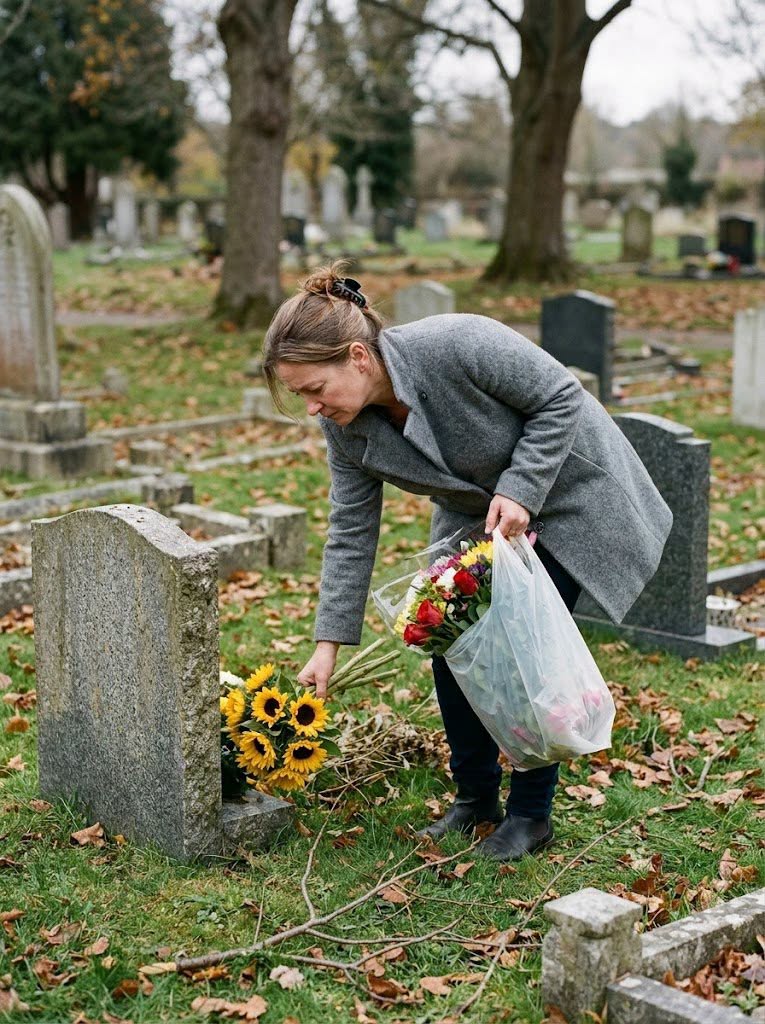
I stood in front of Edward’s grave for several minutes, unable to stop staring at the sunflower in the woman’s hand.
It was one of the three I had brought that morning. I had placed them carefully beside his headstone, just as I had done every year since the accident. I even trimmed the stems with my pruning shears so they would sit neatly against the small vase.
But now this stranger was walking away with one.
“Excuse me!” I called, my voice shaking. “That flower belongs to my son.”
The woman stopped.
She was probably in her late sixties, wearing a faded brown coat and carrying an old canvas bag. When she turned around, I noticed several other flowers inside it.
“I’m sorry,” she said quietly. “I didn’t mean to upset you.”
“Then why are you taking flowers from his grave?”
She looked down at the sunflower.
“Because I thought he wouldn’t mind.”
I stared at her, confused and angry.
“You didn’t know my son.”
For a moment, she said nothing. Then she glanced across the narrow cemetery road toward an old brick building that I had never paid much attention to.
“I think you should come with me,” she whispered.
“I don’t have anywhere to go with you.”
She nodded as though she expected that answer.
“My name is Margaret. I’ve been coming here every Saturday for almost eleven years. And your son… Edward was the reason I started.”
My anger suddenly gave way to confusion.
“What are you talking about?”
She walked toward the building, and after a moment, I followed.
At the back was a narrow door with a rusty handle. Margaret reached into her coat pocket and pulled out a small key.
When she opened it, I saw a room filled with wooden shelves, old tools, flowerpots, watering cans, and photographs.
But it was the sign above the workbench that made my knees feel weak.
EDWARD’S GARDEN
I stepped closer.
There were photographs of my son everywhere.
Edward holding a shovel. Edward laughing beside a group of children. Edward kneeling beside an elderly man in a wheelchair, helping him plant flowers in a small pot.
I touched one of the photographs with trembling fingers.
“Where did you get these?”
Margaret wiped her eyes.
“Your son used to come here every Saturday morning. He repaired things, planted flowers, cleaned the grounds, and helped people who couldn’t afford to maintain their loved ones’ graves.”
I shook my head.
“Edward never told me any of this.”
“I know,” she replied. “He didn’t want anyone to know. He said kindness wasn’t something you did to receive applause.”
She pointed toward a wooden bench.
“Eleven years ago, I lost my husband. I stopped visiting his grave because I couldn’t bear the pain. One rainy afternoon, Edward found me sitting outside this building. He asked why I was crying. I told him I couldn’t afford flowers for my husband’s birthday.”
Margaret paused.
“He disappeared for about twenty minutes. When he returned, he was carrying a bunch of sunflowers. He placed them in my hands and said, ‘Nobody should have to visit someone they love with empty hands.'”
My eyes filled with tears.
That sounded exactly like my Edward.
Margaret continued.
“After that, he started helping people here. Some were elderly. Some had no family nearby. Some couldn’t afford flowers. He built this little garden so everyone could have something beautiful to remember their loved ones.”
I looked around the room again.
On the workbench sat a dusty metal toolbox.
I recognized it immediately.
It was Edward’s.
The same toolbox he used to carry whenever he visited me.
My hands began shaking as I opened it. Inside were his old gardening gloves, a small notebook, and a folded envelope with my name written across it.
I couldn’t breathe.
“Why do you have this?”
Margaret looked down.
“He left it here shortly before he died. He asked me to give it to you someday, when you were ready.”
I carefully unfolded the letter.
Mom,
If you’re reading this, I hope you know that I never stopped bringing you sunflowers because I thought they were beautiful. I brought them because you always smiled when you saw them.
You once told me that flowers make an ordinary day feel special. I wanted to give that feeling to as many people as I could.
I’ve started a little garden for people who don’t have anyone to care for their graves. I hope it grows bigger someday.
And Mom, if I ever leave before you do, please don’t let my grave become the only place where you remember me.
Plant something. Help someone. Give somebody a reason to smile.
That’s where you’ll find me.
Love, Edward.
I couldn’t finish the letter without crying.
For eleven years, I had believed that I was the only person who missed my son as desperately as I did.
But in that little room, surrounded by photographs, tools, and flowers, I discovered that Edward had left pieces of himself all over the world.
I turned toward Margaret.
“Why were you taking flowers from his grave?”
She gently smiled.
“Because today is his birthday. Every year, I take one sunflower from his grave and give it to someone who has forgotten that they’re not alone. Edward started that tradition.”
She opened her canvas bag and showed me the flowers.
“These are for people whose families haven’t visited in months. I never take them without permission. Edward always told me that a flower should keep moving until it finds someone who needs it.”
I looked at the sunflower in her hand.
Then I began to cry again, but this time the tears felt different.
I had arrived at the cemetery believing someone had stolen something from my son.
Instead, I had discovered how much of him was still alive.
The following Saturday, I returned with twenty-five sunflowers.
Margaret was waiting outside Edward’s Garden.
Together, we cleaned the shelves, repaired the old workbench, and planted new flowers along the building.
I also placed a small wooden sign above the entrance.
EDWARD’S GARDEN — NO ONE SHOULD HAVE TO REMEMBER SOMEONE ALONE.
And every year, on my son’s birthday, I still bring sunflowers to his grave.
But I no longer leave all of them there.
Some go to strangers. Some go to forgotten graves. And some go to people sitting quietly in the cemetery, holding memories they don’t know how to carry.
Because my son taught me something I will never forget:
Love doesn’t end when someone dies. Sometimes, it simply finds new people to reach.