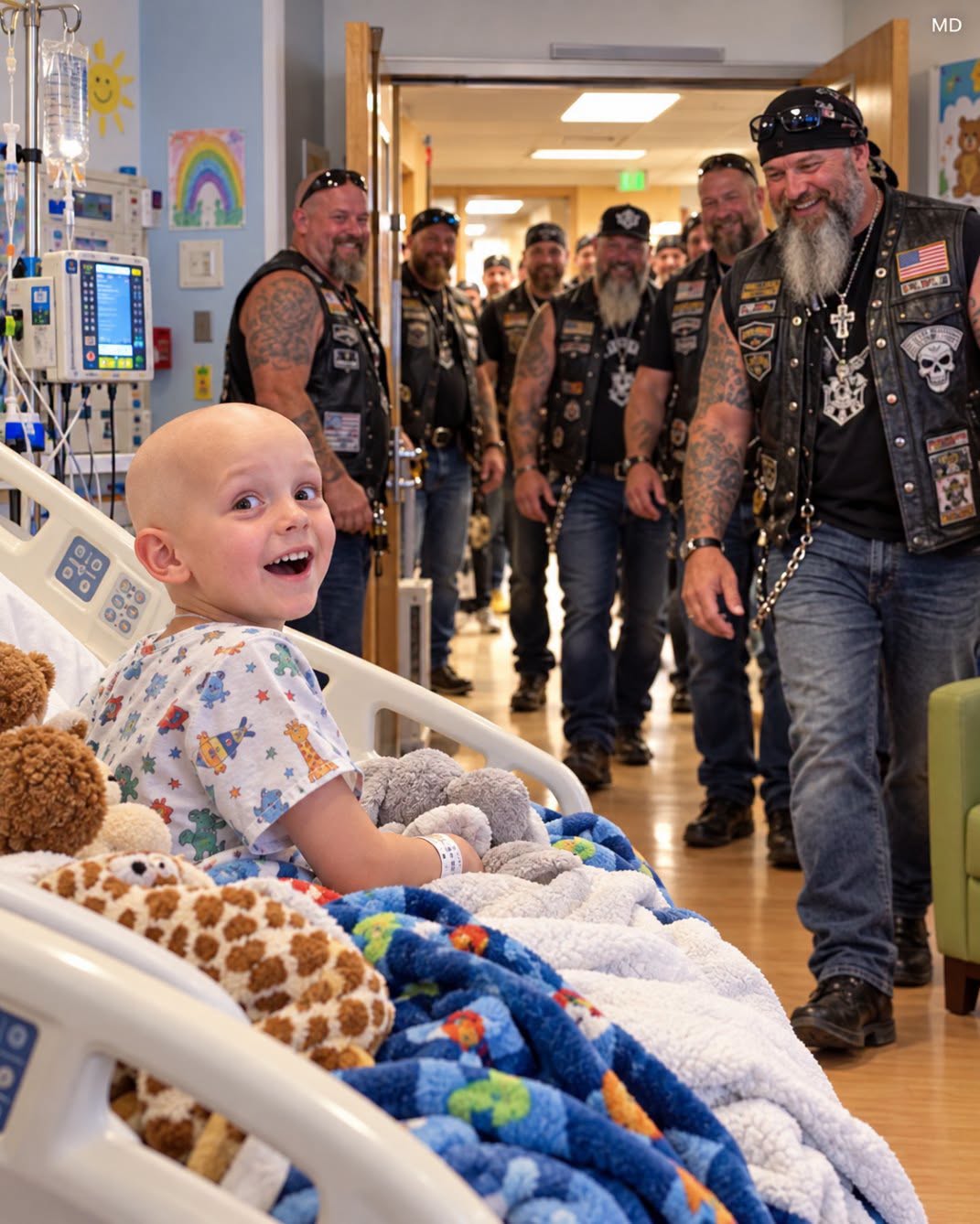
I nearly called hospital security when twelve tattooed men wearing leather vests walked into my 12-year-old son’s hospital room. But what happened over the next few minutes changed the way I looked at strangers, kindness, and the people who show up when life becomes unbearable.
My name is Bridget, and my son, Drew, had been given approximately three months to live. His cancer had continued spreading despite treatment, and every new appointment seemed to bring another painful conversation about what we could no longer do. I had become an expert at smiling in front of him, crying in hospital bathrooms, and pretending that I wasn’t terrified of the future.
Drew had three dreams he talked about constantly. He wanted to see the ocean, own a dog, and ride a motorcycle someday. They weren’t extravagant wishes. They were the ordinary dreams of a boy who wanted more time than the doctors believed he had.
His father had disappeared from our lives years earlier, leaving me to raise Drew alone. Since then, I had learned to handle everything myself. I managed the medical bills, sat through chemotherapy sessions, and stayed awake beside his hospital bed whenever his pain became too much. I rarely asked for help because I had learned that promises were easy to make and much harder to keep.
Then Dr. Harris joined Drew’s medical team.
He was enormous, with a shaved head, heavily tattooed arms, and a deep voice that seemed to fill every room he entered. The first time I saw him, I instinctively pulled Drew’s blanket closer.
I felt embarrassed by my reaction, but I couldn’t help it. I had spent so much time protecting my son that anyone who looked intimidating immediately made me nervous.
My mother noticed, too.
“Are you sure he’s the right doctor for Drew?” she whispered one afternoon. “He doesn’t exactly look like someone you’d expect to find in a children’s hospital.”
I didn’t answer. I was thinking the same thing.
But Dr. Harris surprised me.
He never spoke to Drew as if he were fragile or already gone. He asked about his favorite video games, laughed at his terrible jokes, and listened patiently when Drew described the motorcycle he hoped to ride someday.
Most importantly, he never made promises he couldn’t keep.
When Drew asked whether he would get better, Dr. Harris sat beside his bed and answered honestly without taking away his hope.
“We’re going to keep taking care of you,” he told him. “And we’re going to make sure your time is filled with as much comfort and happiness as possible.”
For the first time in weeks, Drew smiled at a doctor.
I began to trust Dr. Harris, although I still didn’t understand why he seemed so personally invested in making my son’s remaining time meaningful.
Then came the afternoon I will never forget.
I was sitting beside Drew’s bed, helping him finish a puzzle, when the hospital room door opened.
One man walked in.
Then another.
And another.
Within seconds, twelve men stood inside the room.
They were broad-shouldered, heavily tattooed, and dressed in black leather vests bearing motorcycle club insignia. Some had long beards. Others wore bandanas. Their boots made heavy sounds against the hospital floor, and several carried large bags.
My heart began racing.
I stood up immediately.
“Excuse me,” I said, trying to keep my voice steady. “Who are you? You can’t all come in here.”
The largest man raised both hands.
“Ma’am, we’re not here to cause trouble.”
I reached for my phone anyway.
Drew, however, was staring at them with wide eyes.
Then he whispered something that made me stop.
“Mom, are they here for me?”
Before I could answer, Dr. Harris appeared in the doorway behind them.
He looked at me, then at Drew, and smiled.
“Bridget,” he said gently, “I’d like you to meet some friends of mine.”
I couldn’t understand what was happening.
One of the men stepped forward. His beard reached almost to his chest, and his arms were covered in tattoos. He looked like the sort of person I would have crossed the street to avoid a few months earlier.
He knelt beside Drew’s bed.
“Hey, buddy,” he said. “I hear you’ve got some big dreams.”
Drew nodded cautiously.
“The ocean,” the man continued. “A dog. And a motorcycle.”
Drew’s eyes filled with tears.
“How do you know that?”
The man glanced at Dr. Harris.
“Because your doctor told us about you.”
I turned toward Dr. Harris, confused.
He pulled a chair beside me and explained that he had spent years volunteering with a local motorcycle group that organized rides and community events for children facing serious illnesses.
When he learned about Drew’s diagnosis and his dreams, he contacted several friends.
“They wanted to do something meaningful for him,” Dr. Harris explained. “Something that would give him a reason to look forward to tomorrow.”
I looked at the men again.
One of them opened a bag and carefully pulled out a collection of motorcycle magazines, toy bikes, and photographs of motorcycles of every shape and color.
Another produced a small stuffed dog.
A third handed Drew a card signed by members of the group.
But the man who had knelt beside the bed wasn’t finished.
“My name’s Mike,” he told Drew. “And we’d like to help you make at least one of those dreams come true.”
Drew looked at him, barely breathing.
“Which one?”
Mike smiled.
“The motorcycle.”
For a moment, I couldn’t speak.
I had spent months trying to prepare myself for losing my child. Every day had become a battle between hope and grief, and I had begun to believe that the only thing left to do was keep Drew comfortable and protect him from disappointment.
These twelve strangers were offering him something I thought we had run out of.
Something to anticipate.
Something to remember.
Something joyful.
And I had nearly called security.
I covered my mouth as tears streamed down my face.
“I’m sorry,” I whispered. “I thought—”
Mike shook his head.
“Ma’am, you don’t owe us an apology. You’re protecting your boy. That’s what a mother does.”
Those words broke through the last of my defenses.
I sat down beside Drew and held his hand as the room filled with conversation and laughter. The men told him about their motorcycles, showed him photographs from their rides, and answered every question he asked.
For the first time in a long while, Drew wasn’t talking about chemotherapy, scans, or how much his body hurt.
He was talking about engines.
He was asking about helmets.
He was imagining the wind against his face.
And he was smiling.
Before they left, the men promised to return with a special surprise. They didn’t ask for money or publicity. They didn’t take photographs of Drew without permission or make a show of their generosity.
They simply told him they would see him soon.
After the room quieted, I turned to Dr. Harris.
“Why are you doing all this?” I asked. “You already have so much to do as his doctor.”
He was silent for a moment.
Then he pulled back his sleeve slightly, revealing a small tattoo near his wrist.
It was a name.
His younger brother’s name.
Dr. Harris explained that his brother had died of cancer when they were teenagers. Back then, he had been angry, frightened, and convinced that there was nothing he could do to make his brother’s final months better.
He had spent years carrying that helplessness with him.
Eventually, he became a doctor.
“I can’t promise every child a cure,” he said quietly. “But I can promise that being sick won’t make them any less deserving of joy. And I can remind their families that they don’t have to face everything alone.”
I looked at the man I had judged by his appearance and felt ashamed.
His tattoos didn’t tell me who he was.
His shaved head didn’t tell me how much compassion he carried.
And his size certainly didn’t tell me how gentle he could be with a frightened child.
Over the next several days, the motorcycle group kept its promise.
They arranged a special visit outside the hospital, working with the medical team and following every safety precaution. Drew couldn’t simply climb onto a motorcycle and ride down the highway, but the men brought a beautiful touring motorcycle to a permitted area where he could see it up close.
Mike helped Drew sit on the stationary bike while another member held it securely. Drew wore a properly fitted helmet, and his mother stood beside him with one hand over her mouth.
The men explained the controls, let him hear the engine, and answered his endless questions.
Drew laughed so hard that I began crying again.
Not because I was sad.
Because for a little while, I could see my son being a boy again.
Not a patient.
Not a diagnosis.
Not a countdown on a doctor’s calendar.
Just Drew.
A twelve-year-old boy living one of his dreams.
The group also helped us arrange a visit to the ocean when Drew’s condition and medical team allowed it. The journey required careful planning, but the thought of seeing the waves gave him something wonderful to talk about during the difficult days that followed.
When he finally stood near the shoreline, he watched the water roll toward the sand and whispered, “It’s bigger than I imagined.”
I wrapped my arm around his shoulders.
“Yes,” I told him. “It is.”
He leaned against me, smiling at the horizon.
For that moment, the hospital rooms, the treatments, and the frightening conversations seemed far away.
I don’t know how many more moments like that life would give us. No one could tell me exactly how Drew’s story would unfold, and I eventually learned to stop measuring every day against a prediction.
Instead, I began measuring them by the things that mattered.
A shared joke.
A favorite meal.
A conversation that lasted longer than expected.
The sound of my son laughing.
And the kindness of people who had walked into our lives when we needed it most.
Dr. Harris continued caring for Drew, and the motorcycle group continued checking on us. They never pretended they could change the medical reality we faced. They simply showed up, again and again, proving that compassion doesn’t need to solve every problem to make a difference.
I often think about that first afternoon.
Twelve tattooed men walked into my son’s hospital room, and my first instinct was fear.
I saw their leather vests before I saw their kindness. I noticed their size before I noticed their gentleness. I judged them before giving them a chance to show me who they were.
They, on the other hand, saw a little boy with dreams.
And they decided those dreams mattered.
I learned something that day that I will carry with me for the rest of my life:
You cannot always tell who has a good heart by looking at them.
Sometimes, the people who appear the most intimidating are the ones who will sit beside your child, hold his hand, and help him find a little happiness when the world feels unbearably cruel.
And sometimes, the greatest gift anyone can give a family facing heartbreak isn’t a miracle or a promise that everything will be all right.
Sometimes, it’s simply showing up.
Because when life becomes frightening and uncertain, the people who choose to stand beside us can remind us that even in our darkest moments, we are not alone.