When Emma’s daughter’s kindergarten was evacuated because of a gas leak, she had twenty minutes to collect the five-year-old. Emma called everyone she knew, including her manager, but nobody answered. Afraid that missing another shift would cost her the only income keeping them housed, she made a desperate choice: she brought Sandra to work and hid her in a quiet storage room. Two hours later, Emma’s boss discovered the child and fired her in front of the entire office. By the following morning, however, one forgotten drawing had exposed exactly what kind of manager he was.
Emma was thirty-one and held a business degree, but after years of being rejected for jobs because she lacked experience, she accepted a cleaning position. Sandra’s father had disappeared years earlier, leaving Emma without child support or family nearby. Every paycheck went toward rent, food, and kindergarten.
Emma had never imagined that her life would turn out this way. At university, she had dreamed of working in a business office, wearing professional clothes and building a career she could be proud of. But after Sandra was born, survival became more important than ambition. She learned to stretch groceries, postpone bills, and smile at her daughter even when she lay awake at night worrying about the rent.
The cleaning job wasn’t glamorous, but it paid regularly. Emma arrived early, stayed late when necessary, and made sure every desk, conference room, and hallway was spotless. She rarely complained because she knew how easily one paycheck could separate a family from stability.
Her manager, Richard, often reminded employees that the company had rules for a reason. He expected punctuality, unquestioning obedience, and results. To him, personal problems were distractions that belonged outside the office.
Emma understood the rules. She had followed them faithfully.
Until the morning the kindergarten called.
She was wiping down a conference table when her phone vibrated. The caller explained that a suspected gas leak had forced the school to evacuate the children. Parents had to collect them immediately.
Emma felt her stomach tighten.
She called the neighbor who sometimes helped with Sandra. No answer. She tried another parent from the kindergarten. Nothing. Then she called Richard, hoping he might allow her to leave for half an hour.
His phone went straight to voicemail.
She sent a message explaining the emergency, but no reply came.
Emma looked at the clock. Every passing minute made her more frightened. She couldn’t leave Sandra waiting, but she couldn’t afford to lose her job either. Her rent was due in a few days, and she had almost nothing left in her bank account.
Finally, she made the decision she would later wish she had never needed to make.
She collected Sandra and brought her to the office.
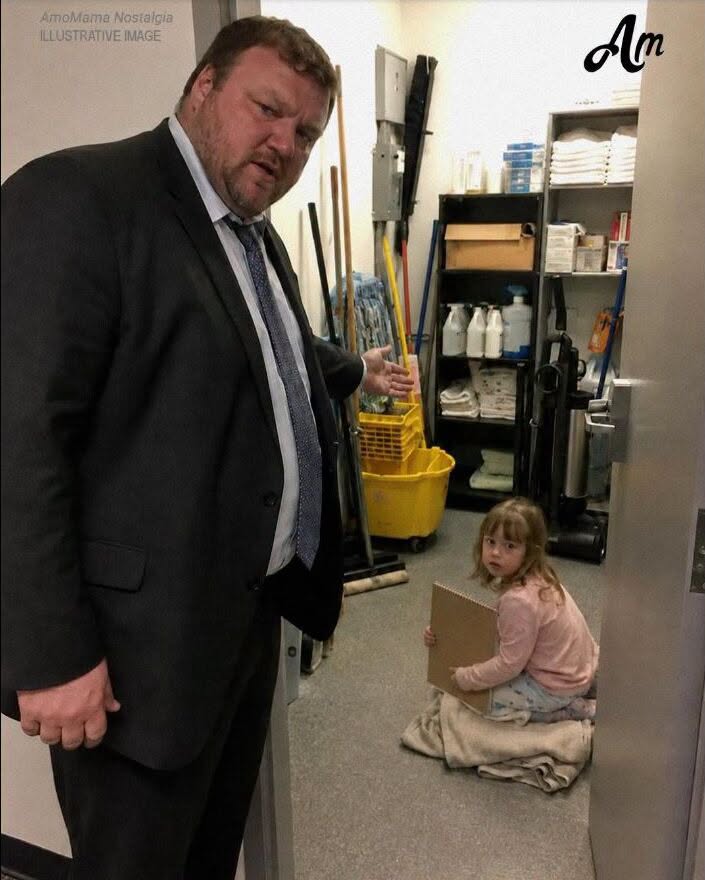
Emma told her daughter to stay in a small storage room near the supply closet, where there were chairs, paper, and a little space away from the busy corridors. She gave Sandra her phone, a bottle of water, and a packet of crackers.
“Mommy has to finish her work,” she whispered, brushing the girl’s hair away from her face. “Stay here, sweetheart. I’ll check on you.”
Sandra nodded. She was only five, but she had already learned that her mother sometimes had to make difficult choices.
To keep her occupied, Emma gave her a sheet of paper and a handful of colored pencils from a supply box.
“Why don’t you draw us a picture?” she suggested.
Sandra smiled and began drawing.
For the next two hours, Emma worked nervously, checking the time whenever she could. She hurried through her cleaning tasks and listened for any sign that someone had discovered her daughter.
Then she heard Richard’s voice.
“What is a child doing in my building?”
Emma’s blood ran cold.
Richard stood at the storage-room doorway, staring at Sandra. The little girl sat on the floor, surrounded by colored pencils and paper.
Emma rushed over.
“Please, let me explain,” she said. “Her kindergarten was evacuated because of a gas leak. I called you, but I couldn’t reach anyone. I had nowhere else to take her, and I couldn’t leave her alone.”
Richard’s expression hardened.
“This is a workplace, not a daycare center. You brought a child into a restricted area without permission?”
“I know I shouldn’t have,” Emma replied, her voice trembling. “I was trying to keep her safe. It was an emergency.”
Instead of lowering his voice, Richard called several employees over.
“Everyone needs to understand that company policies are not optional,” he announced. “This is what happens when people decide the rules don’t apply to them.”
Emma stood motionless as her colleagues gathered around. Some looked uncomfortable. Others stared at the floor.
Then Richard delivered the words that made her feel as though the ground had disappeared beneath her feet.
“You’re fired. Effective immediately.”
Emma stared at him.
“Please,” she whispered. “I need this job. I have a daughter to support. I have never missed work without a reason.”
“You should have thought about that before bringing your personal problems here,” he replied.
Sandra heard everything.
She stood up, clutching the drawing she had just finished. Her eyes filled with tears as she reached for her mother’s hand.
“Mommy, did I do something bad?”
That question broke Emma’s heart.
“No, baby,” she said, kneeling to hug her. “You didn’t do anything wrong.”
She collected her belongings, held Sandra’s hand, and walked out of the building with tears running down her face.
She had entered that office believing she was doing everything possible to protect her daughter’s future. She left feeling as though she had failed her.
But the story didn’t end there.
The forgotten drawing
The following morning, Richard arrived at the office expecting another ordinary day.
On his desk lay a folded sheet of paper.
Someone had found it in the storage room after Emma left. The drawing had Sandra’s name written in large, uneven letters at the top.
Richard almost tossed it into the trash.
Then he noticed the picture.
Sandra had drawn a tall building with rows of windows. Inside one window stood a little girl holding her mother’s hand. The mother wore a blue shirt, and beside her was a smiling sun.
Above the building, in letters a five-year-old had carefully copied, were the words:
“MY MOMMY WORKS HERE. SHE HELPS PEOPLE.”
Underneath, Sandra had written a few more words, some of the letters backward.
“Mommy says work is important because it helps us have a home. I want to work with Mommy when I grow up.”
Richard stared at the page.
For the first time since the previous afternoon, he remembered Emma not as an employee who had broken a rule, but as a mother who had been desperately trying to keep her child safe.
Yet the drawing contained something else.
At the bottom, Sandra had drawn several small figures standing together. One wore a tie and stood apart from the others. Above that figure, she had written a single word Emma had apparently taught her to recognize.
“BOSS.”
Richard could not know exactly what Sandra had been thinking when she drew the picture. But he could see the simple truth behind it: to that little girl, her mother’s workplace was somewhere her mother helped others, worked hard, and earned the money that kept their home standing.
And he had turned that place into somewhere her mother was humiliated.
Richard folded the drawing and put it in his desk drawer.
He could have forgotten the incident. He could have told himself that he was simply enforcing company policy. But the words on the paper stayed with him throughout the morning.
Then an email arrived from the human resources department.
It requested a written explanation of Emma’s dismissal after a colleague had reported that she had been fired immediately after a documented childcare emergency. The colleague had also mentioned that Emma had attempted to contact Richard before bringing her daughter to the office.
Richard’s earlier message about company policy was included in the record. So were the timestamps of Emma’s unanswered calls.
Suddenly, the decision he had made in front of the entire team no longer looked like an example of strong leadership.
It looked like a failure to exercise judgment.
The meeting that changed everything
By lunchtime, Richard had been asked to meet with the HR director.
He explained that children were not permitted in restricted workplace areas. The rule existed for safety reasons, and he insisted he had acted to protect the company.
The HR director agreed that workplace safety mattered. But she asked a question he had not considered.
“Did you explore any alternatives before dismissing her? Did you ask whether the child was safe? Did you consider whether Emma had any reasonable way to respond to an unexpected evacuation?”
Richard had no good answer.
He had enforced the rule without considering the circumstances. Worse, he had publicly humiliated an employee who had spent years doing difficult work reliably.
The company began reviewing the circumstances of the dismissal and its procedures for emergencies involving employees with caregiving responsibilities. Richard was instructed not to make further decisions about Emma’s employment while the review was underway.
That afternoon, he found Emma’s phone number in the employee directory.
He called.
Emma answered cautiously. She had spent the morning contacting other businesses, hoping to find another cleaning job before her rent became overdue.
“Emma,” Richard began, “I’ve been thinking about what happened yesterday.”
She said nothing.
“I was wrong to handle it the way I did. You were facing an emergency, and I humiliated you in front of your colleagues. I’m sorry.”
Emma gripped the phone.
An apology was more than she had expected, but it wouldn’t pay the rent or replace the income she had lost.
“Why are you calling me?” she asked quietly.
“HR is reviewing the decision. I would like to discuss the possibility of bringing you back.”
Emma closed her eyes.
Part of her wanted to say yes immediately. She needed the money, and she had worked hard to keep that position. But another part remembered Sandra asking whether she had done something bad.
“I need a job,” Emma replied. “But I also need to know that if another emergency happens, I won’t be treated like I’m a bad person for trying to protect my daughter.”
Richard was silent for a moment.
“That’s fair,” he said.
The company ultimately offered Emma her position back, with her employment record corrected to reflect the review’s outcome. HR also established a clearer process for employees facing urgent family emergencies, including a designated contact and a procedure for requesting temporary leave.
Richard was required to participate in management training and address the way he had handled the incident.
Emma considered the offer carefully before accepting. She returned to work not because everything had suddenly become perfect, but because she needed stability and wanted to continue building a better future for Sandra.
On her first morning back, she found a small envelope on her desk.
Inside was Sandra’s original drawing.
Richard had returned it.
There was a note attached.
“I should have remembered that the people who work in this building have lives outside it. Your daughter deserves to see her mother treated with respect. I failed to show that respect, and I’m sorry.”
Emma read the note twice before placing it safely in her bag.
That evening, she showed Sandra the drawing.
“Does this mean I can come to your work again?” Sandra asked.
Emma smiled gently.
“Not without permission, sweetheart. We still have to follow the rules. But it means that grown-ups have to learn how to make good decisions, too.”
Sandra considered this, then nodded as if it made perfect sense.
A lesson bigger than one drawing
Weeks later, Emma was back to her familiar routine. She worked hard, saved what she could, and continued looking for opportunities that might eventually allow her to use her business degree.
Nothing about her life became effortless overnight. The bills still arrived, Sandra still needed her mother, and unexpected problems still appeared.
But Emma no longer believed that needing help made her a failure.
And Richard had learned something that no management handbook had ever taught him: enforcing a rule is easy when you refuse to look at the person standing in front of you. Leadership requires something harder—judgment, compassion, and the courage to admit when you have been wrong.
Sandra’s drawing had not magically solved every problem in her mother’s life. It had done something more important: it had forced the adults around her to look beyond a policy and recognize the human beings affected by it.
Sometimes, the smallest voices reveal the biggest truths.
A five-year-old had drawn a picture of her mother helping people. She hadn’t intended to expose anyone, demand an apology, or change a workplace. She had simply drawn what she believed about the person she loved most.
And that innocent picture reminded everyone who saw it that a person’s worth cannot be measured by their job title, their salary, or their ability to keep personal struggles out of sight.
Behind every employee is a life. Behind every parent is someone trying to provide, protect, and keep going. And behind every difficult decision may be a person who needs understanding rather than humiliation.
The real measure of a manager isn’t how quickly they can punish someone for breaking a rule. It’s whether they can recognize when compassion, fairness, and common sense should guide what happens next.