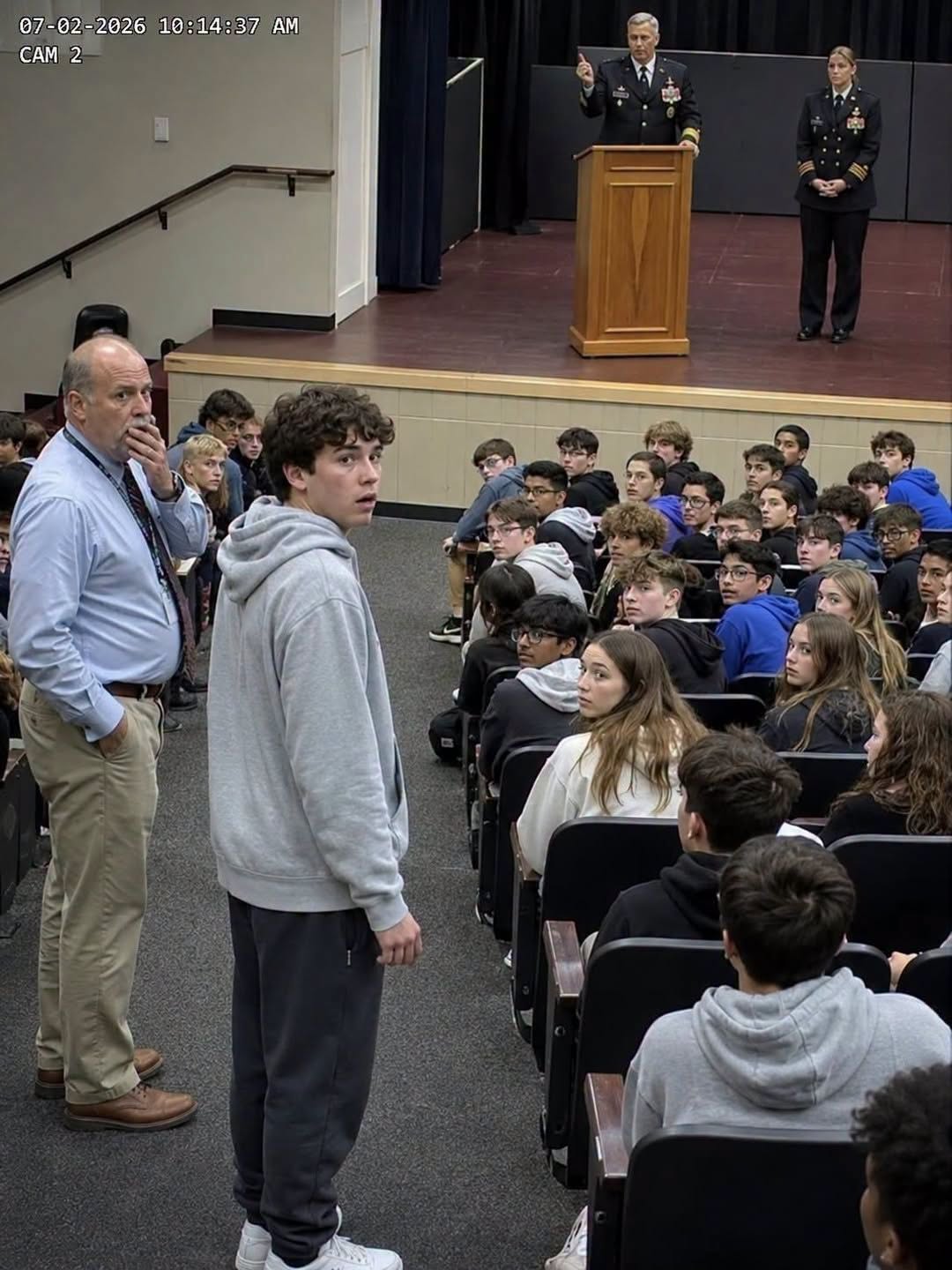
My teacher turned my proudest moment into a public humiliation. At thirteen, I stood trembling before an auditorium as laughter swallowed my presentation about my mother, Captain Rachel Miller, pictured beside an F-22 in her flight suit. They called her probably just a secretary who liked old airplanes, while behind me, her photograph held a quieter, painfully personal truth.
I had rewritten my note cards four times before stepping behind that wooden podium. The assignment was about a hero, and choosing mine had been easy. In the photograph I brought, my mother stood beneath a gray Nevada sky, her hair tucked under a helmet. She looked younger, with a small, tired smile. One hand rested on the aircraft beside her, a gesture so familiar and gentle that it reminded me of someone touching an old friend’s shoulder.
Then my teacher reduced her to a punch line, and the room followed along. There was nothing shameful about being a secretary; the cruelty was in treating my mother’s identity as something laughable and my admiration as something foolish. My hands shook over the cards. I had come prepared to explain why Captain Rachel Miller was my hero—not to hear an auditorium dismiss the woman whose photograph I had so proudly chosen.
“Go ahead,” my teacher said, suppressing a smile. “Tell us more about your mother’s little hobby.”
A few students laughed again.
I looked down at my note cards, but the words seemed to blur. I could hear my heartbeat louder than the whispers behind me. For one terrible moment, I considered walking away, gathering my photograph, and pretending the whole thing had never happened.
Then I remembered something my mother had told me after I failed to make the school basketball team.
“Being brave doesn’t mean you never feel embarrassed or afraid,” she’d said. “It means you don’t let those feelings decide who you are.”
I took a slow breath and looked up.
“My mother isn’t a secretary,” I began, my voice barely audible. “She’s a captain in the United States Air Force.”
The laughter faded, but my teacher still looked unconvinced.
I swallowed and continued.
“She flies the F-22 Raptor.”
Someone in the back whispered, “No way.”
I heard another snicker, and my cheeks burned. I wanted to tell them they were wrong, that they had no idea what my mother did every day, but I knew arguing wouldn’t make them understand.
So I stopped trying to defend her with titles.
Instead, I told them about the woman who woke up before sunrise, quietly made breakfast, and checked my homework before leaving for work. I described how she called me whenever she had a chance, even if it meant only a few minutes between demanding responsibilities. I told them about the nights she came home exhausted but still sat on the edge of my bed to ask about my day.
“My mother doesn’t tell me every detail about her job,” I explained. “Some things are private. But I know she works hard, she takes responsibility seriously, and she understands that other people’s lives can depend on her decisions.”
The auditorium had grown quieter.
I turned toward the photograph.
“When I look at this picture, I don’t just see a fighter jet. I see the person who taught me to keep my promises, admit my mistakes, and keep going when something is difficult. She doesn’t need to be famous for me to be proud of her.”
My voice cracked on the final sentence.
I glanced at my teacher, hoping to find some sign that she understood what her words had done. Instead, she folded her arms and interrupted.
“That’s a very emotional story, but we asked for facts. Anyone can claim their parent has an impressive job.”
The room fell silent again.
This time, the silence felt different.
A student near the front slowly lowered his phone. Another looked at the photograph more carefully. I could feel tears gathering in my eyes, but I refused to let them fall in front of everyone.
I gathered my note cards.
“I’m finished,” I said.
And I stepped away from the podium.
I barely remembered walking back to my seat. My face burned, my stomach hurt, and I spent the rest of the school day wishing the floor would open beneath me. By the time the final bell rang, I had convinced myself that I should never have brought the photograph at all.
When I reached home, my mother was sitting at the kitchen table, still wearing her uniform trousers and a plain gray shirt. She had returned from work earlier than expected and was sorting through some paperwork.
She looked up as soon as I walked in.
“Hey, kiddo. How did your presentation go?”
That simple question nearly broke me.
I dropped my backpack beside the door and burst into tears.
Mom was beside me in seconds. She didn’t demand an explanation or tell me to calm down. She wrapped her arms around me and waited until I could speak.
Between sobs, I told her everything: the laughter, the secretary joke, the accusations, and the way my teacher had made me feel foolish for being proud of her.
For a long moment, Mom said nothing.
Then she pulled back and gently wiped my cheeks.
“Look at me,” she said.
I did.
“You have absolutely nothing to be ashamed of.”
“But everyone laughed.”
“I know.”
“They thought I was lying.”
“That’s painful, sweetheart. I understand.”
I stared at her uniform trousers and the familiar watch on her wrist.
“Why didn’t you tell me what to say if someone didn’t believe me?”
Mom gave me a sad little smile.
“Because I never imagined someone would treat you that way for talking about someone you love.”
She sat beside me and explained that there were many things about her work she could share, but there were also responsibilities and details she had to keep private. She had never wanted her career to become something I felt obligated to prove to other people.
“Your job wasn’t to convince everyone in that room that I’m important,” she told me. “Your job was to tell them why she’s important to you.”
I looked at her.
“But they didn’t listen.”
“Some people won’t listen, even when you tell the truth. That doesn’t make the truth less true.”
I leaned against her shoulder, allowing myself to cry a little longer.
Then she said something I would remember for the rest of my life.
“Courage isn’t always standing in front of an audience and winning them over. Sometimes it’s walking away without letting their cruelty change how you see yourself.”
That evening, Mom didn’t call my teacher. She didn’t contact the principal or demand an apology. She listened to me, made dinner, and helped me prepare for the next school day.
But the story didn’t end there.
The following morning, our school principal called Mom.
Apparently, several students had spoken to their parents about what happened. One student had described the presentation to his father, a retired Air Force mechanic. Another had told her older brother, who had served in the military. Word had spread beyond the classroom, and questions were being raised about why a teacher had publicly mocked a student instead of encouraging her.
My mother agreed to attend a meeting with the principal and my teacher.
I wasn’t required to attend, but I asked to come.
I wanted to be there—not to embarrass my teacher in return, but because I had spent the previous day feeling as though my voice didn’t matter. I wanted to learn how to use it without being cruel to someone else.
The principal greeted us in a small conference room. My teacher sat across the table, her hands folded in front of her.
Mom wore her service uniform.
She didn’t arrive with medals displayed for attention or with a dramatic speech prepared. She simply introduced herself as Captain Rachel Miller, answered the principal’s questions about her career, and explained why she had chosen not to discuss certain professional details with her child.
Then she turned to my teacher.
“I understand that students should support their presentations with reliable information,” she said calmly. “If my daughter’s work lacked evidence, you could have asked her to clarify it or offered guidance. But questioning her honesty in front of an auditorium and inviting others to laugh at her was unnecessary.”
My teacher shifted in her chair.
“I didn’t intend to upset her,” she replied. “I thought she might have exaggerated the story, and I was trying to make the presentation more engaging.”
Mom nodded once.
“Then you could have asked a question. You didn’t need to make her the joke.”
Nobody spoke for several seconds.
Finally, my teacher turned toward me.
“I’m sorry,” she said. “I should not have spoken to you that way. I should have listened instead of making assumptions.”
I had imagined that moment many times the night before. In my imagination, I delivered a perfect speech and made everyone understand exactly how much they had hurt me.
But sitting there, I discovered that I didn’t want to punish her.
I wanted her to understand.
“Next time,” I said quietly, “please don’t make someone feel stupid for being proud of their family.”
My teacher lowered her eyes.
“You’re right,” she replied.
It wasn’t a magical ending. An apology couldn’t erase the laughter or make me forget how small I had felt standing at that podium. Rebuilding trust would take time, and I wasn’t suddenly comfortable speaking in front of large groups.
But something had changed.
A week later, the school held another assembly. The principal announced a new approach to student presentations: questions would be encouraged, but personal ridicule would not be tolerated. Students would be expected to challenge ideas respectfully rather than turn someone’s vulnerability into entertainment.
My teacher also invited me to deliver a revised version of my presentation to a smaller class.
I hesitated.
The memory of that auditorium still made my stomach tighten.
Mom didn’t tell me I had to do it. She simply asked what I wanted.
After thinking about it for two days, I agreed.
This time, I brought the same photograph.
I stood in front of the class, placed my note cards on the desk, and looked at the students. My hands trembled, but I didn’t hide them.
I told them about my mother, about the discipline her work required, and about the small acts of kindness that mattered just as much to me as her career.
I explained that I couldn’t share every detail of her professional life, but that I didn’t need to know everything about her job to understand the kind of person she was.
When I finished, a girl in the second row raised her hand.
“What does she like to do when she’s not working?”
I smiled for the first time during a presentation.
“She likes terrible science-fiction movies, makes pancakes that are always a little burned, and sings loudly when she thinks nobody can hear her.”
The class laughed, but this time the laughter wasn’t aimed at me.
It was warm.
I laughed with them.
Afterward, a boy approached me and admitted that his father worked in a job he rarely talked about. He said he had always been embarrassed when classmates asked questions he couldn’t answer.
“Maybe I don’t have to explain everything,” he said. “Maybe I can just be proud of him.”
I thought about that sentence long after I went home.
Years later, I would remember that day less for the cruelty of my teacher and more for the lesson my mother gave me afterward.
People will sometimes judge what they don’t understand. They may mistake quietness for weakness, privacy for dishonesty, or pride for arrogance. And sometimes, even people who are supposed to guide us will make mistakes that leave lasting marks.
But their assumptions do not define the people we love.
My mother never needed an auditorium full of strangers to approve of her career. She didn’t need applause to know what she had accomplished, and she didn’t need me to prove her worth.
What she wanted was for me to grow into someone who could stand up for the truth without losing compassion, who could accept an apology without pretending the hurt never happened, and who could remain proud without needing to humiliate anyone else.
I still have that photograph.
The gray Nevada sky, the F-22, my mother’s hand resting gently against the aircraft—all of it remains exactly as it was the day I carried it into school.
But when I look at it now, I no longer see the moment when an auditorium laughed at me.
I see the woman who taught me how to stand back up.
And I remember that the most important thing about a hero isn’t the uniform they wear, the aircraft they fly, or the recognition they receive.
It’s the example they leave behind in the people who love them.