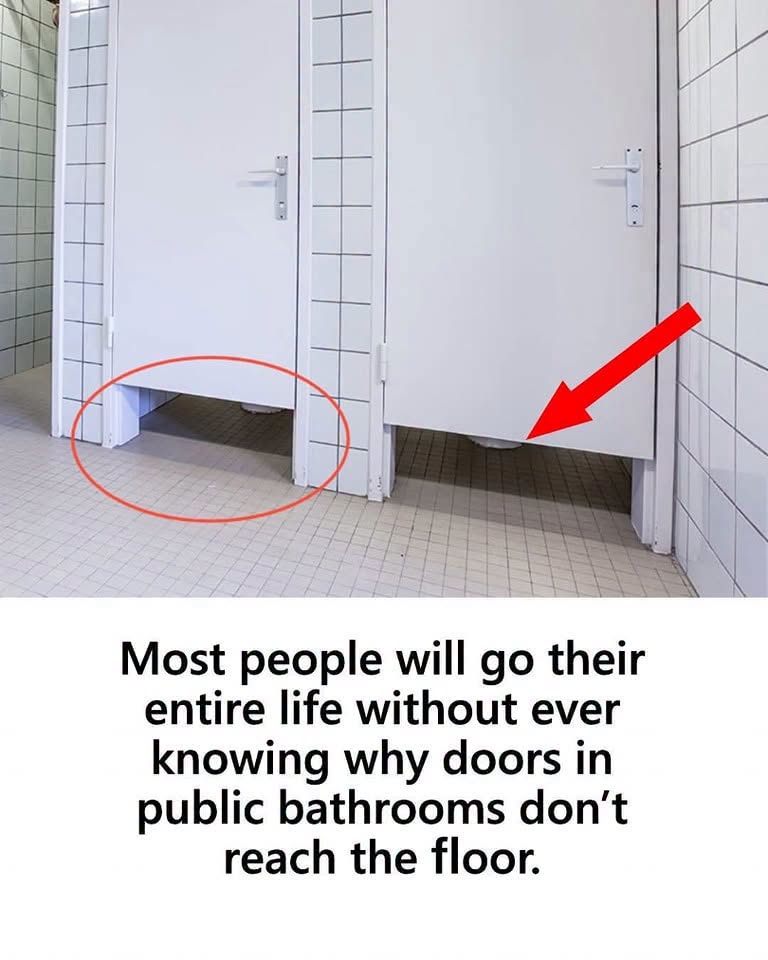
Why Public Bathroom Stall Doors Have Gaps at the Bottom — The Practical Reasons Behind This Uncomfortable Design
That unsettling gap beneath a public bathroom stall door can make an ordinary restroom visit feel surprisingly uncomfortable. You step inside, lock the door, and expect a little privacy. Then you notice the open space beneath the partition, where shoes, shadows, and passing feet remain clearly visible. It can feel like an unnecessary invasion of privacy, but there are practical reasons why this design is so common in public restrooms.
One of the biggest reasons is cleaning and maintenance. Public bathrooms in shopping malls, airports, schools, restaurants, and office buildings can experience heavy traffic throughout the day. The open space allows cleaning staff to sweep, mop, and remove debris beneath the partitions without opening every stall door. This makes routine maintenance faster and helps workers clean hard-to-reach areas more efficiently.
Cost is another important factor. Full-length doors and partitions generally require more material and may need additional structural support. Shorter partitions can be less expensive to manufacture, transport, and install, particularly in facilities containing dozens of stalls. When a building project involves hundreds of restroom fixtures, even modest savings per stall can add up. For businesses and public institutions managing tight budgets, this can make the design attractive.
The gap can also help people recognize whether a stall is occupied. Seeing someone’s feet beneath the door provides a simple visual signal, reducing the chances of someone knocking repeatedly or trying to enter an occupied stall. Although this arrangement does not eliminate awkward encounters, it offers a basic way to communicate occupancy without requiring signs, electronic indicators, or complicated locking systems.
Emergency access is another consideration. If someone inside a stall becomes ill, falls, or cannot respond, the open space may give trained staff or emergency responders additional options for assessing the situation or assisting the person. The gap does not guarantee easy rescue, and emergency procedures still depend on the stall’s construction, but it can sometimes make assistance more practical.
Air circulation is sometimes mentioned as another benefit. Openings between partitions and the floor can allow some air movement within a restroom. However, the gap alone does not ensure good air quality or eliminate unpleasant odors. Effective ventilation systems remain essential for removing moisture and odors from busy bathrooms.
There are also design and accessibility considerations. Public restrooms must accommodate different users, cleaning equipment, and building layouts. Partition heights, door clearances, and floor openings vary according to the facility’s design, applicable building codes, and accessibility requirements. Not every restroom follows the same standard, and the gap is not necessarily the result of one universal rule.
Of course, none of these practical benefits changes the fact that many people would prefer greater privacy. The visible space can make users feel exposed, particularly in crowded restrooms or when children are nearby. Some modern facilities address these concerns with taller doors, smaller side gaps, privacy-focused partitions, and improved locking systems. These designs can provide a more comfortable experience, although they may involve additional installation and maintenance costs.
Ultimately, the gap beneath a public restroom stall door is not simply an oversight. It reflects a compromise between privacy, construction costs, cleaning efficiency, and the practical demands of a heavily used facility. The exact reasons vary from one building to another, but the design often reflects the needs of the people responsible for maintaining the restroom as well as those who use it.
The next time you notice that awkward opening beneath a bathroom stall, remember that a feature that seems inconvenient to visitors may serve several practical purposes behind the scenes. Still, one question remains: should public restrooms prioritize easier maintenance and lower costs, or should greater personal privacy come first?
After all, using a public restroom is an everyday necessity, and a little more privacy could make the experience considerably more comfortable for everyone.