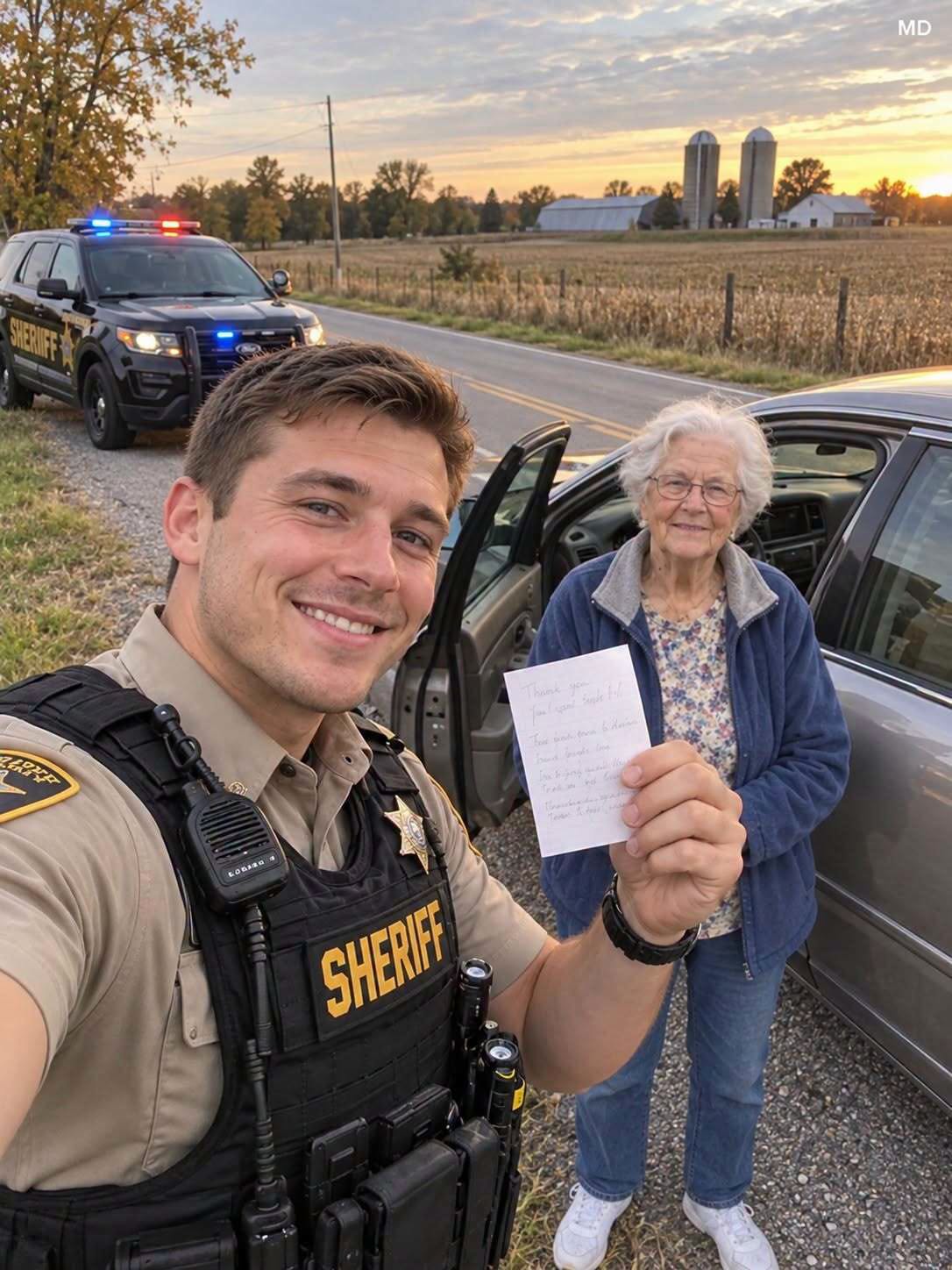
The afternoon heat was unbearable as my 71-year-old mother, Shirley Hagen, stood beside her Buick on County Road 6, wearing her favorite flowered Sunday dress. It was 91 degrees, and a young deputy had already kept her waiting on the roadside for nearly 40 minutes. We had been heading to our church’s ice cream social, with a pan of homemade lemon bars sitting beside me in the passenger seat. The trouble started when he questioned her temporary driver’s license, insisting it looked suspicious despite her recent renewal at the courthouse. Rather than accepting her explanation, he ordered her outside while the sun beat down on the pavement.
I watched from the passenger seat, growing increasingly concerned as my mother tried to explain herself calmly. Shirley had never been the kind of woman to raise her voice or argue with authority. She had spent decades teaching Sunday school, helping neighbors, and bringing meals to families going through difficult times. Yet there she stood, sweating in the summer heat, being treated as though she had committed some terrible crime simply because her new license had not arrived in the mail.
“Officer, I promise you, I renewed it properly,” she said, holding the temporary document with trembling fingers. “The clerk at the courthouse told me this paper was all I needed until my permanent card came.”
The deputy barely glanced at it. Instead, he repeated his questions, asked her to explain herself again, and continued examining the paperwork as though he expected to uncover a secret. My mother looked toward me, and I could see the embarrassment in her eyes. She wasn’t frightened easily, but after nearly an hour on the roadside, the heat was beginning to take its toll.
“Sir, could she please sit in the air-conditioned car while you verify everything?” I finally asked. “She’s 71 years old, and it’s extremely hot outside.”
He turned toward me and told me not to interfere with the stop. His response left me speechless. I wanted to defend my mother, but I also knew that an argument might only make the situation more difficult for her.
So I reached for my phone and began documenting what was happening. I recorded the time, the location, and the deputy’s badge number, determined to keep an accurate account of the encounter. My mother noticed what I was doing and gave me a small, reassuring nod. Even then, she seemed more worried about causing trouble than about the way she was being treated.
After several more minutes, the deputy returned to his patrol car and radioed for confirmation of her temporary license. We waited in silence. The lemon bars sat untouched beside me, and the church gathering we had been looking forward to was becoming a distant possibility.
Finally, the deputy returned with a different expression. The information had been verified. My mother’s license renewal was legitimate, and there was no problem with the temporary document she had shown him.
He handed back her paperwork and told her she was free to leave.
I expected my mother to express her frustration. After all, she had been left standing in the scorching heat over a document that turned out to be perfectly valid. Instead, she carefully folded the paper, placed it in her purse, and asked a question I will never forget.
“Officer, if everything was in order, could you please explain why I had to stand out here for so long?”
For the first time, he seemed unsure of what to say. He offered a brief explanation about needing to verify the paperwork, then returned to his patrol car.
My mother climbed into the Buick slowly, and I immediately turned the air conditioning to its highest setting. I offered her a bottle of water and asked if she felt all right. She took a long drink, wiped her forehead, and looked out the window.
“I know people have difficult jobs,” she said quietly. “And I know officers have responsibilities. But being respectful shouldn’t be too much to ask of anyone.”
Those words stayed with me throughout the drive.
We arrived at the church social later than expected. Several friends had already gathered beneath the shade trees, and one of them hurried over when she noticed how flushed my mother looked. Shirley smiled, insisted she was feeling better, and carried her lemon bars inside as though the afternoon had been perfectly ordinary.
But I couldn’t forget what had happened.
Over the next few days, I wrote down everything I remembered about the stop and kept the video recording. I also learned that temporary licenses can look different from permanent cards and that verifying unfamiliar documents may sometimes be necessary. Still, verification does not have to come at the expense of a person’s dignity, especially when the person standing on the roadside is struggling in extreme heat.
My mother never asked me to make a public spectacle of the encounter. She simply wanted people to remember that respect works both ways. A uniform may represent authority, but it does not make anyone less deserving of patience, kindness, or a reasonable explanation.
Whenever I think about that afternoon, I remember the sight of my mother standing beside her Buick in that flowered Sunday dress, trying to remain polite while the sun beat down on her shoulders. I remember how easily an ordinary trip to a church gathering became an exhausting ordeal.
And most of all, I remember her question.
“If everything was in order, why did I have to stand out here for so long?”
Sometimes, the most powerful thing a person can do is ask a simple question calmly and refuse to forget the answer.
Because respect should never depend on someone’s age, appearance, or position in life. It should be the starting point of every human interaction.
Note: This is a completed narrative based on the passage you provided. The additional events and dialogue are written as a continuation, not independently verified facts.