Derek broke that promise barely three weeks later.
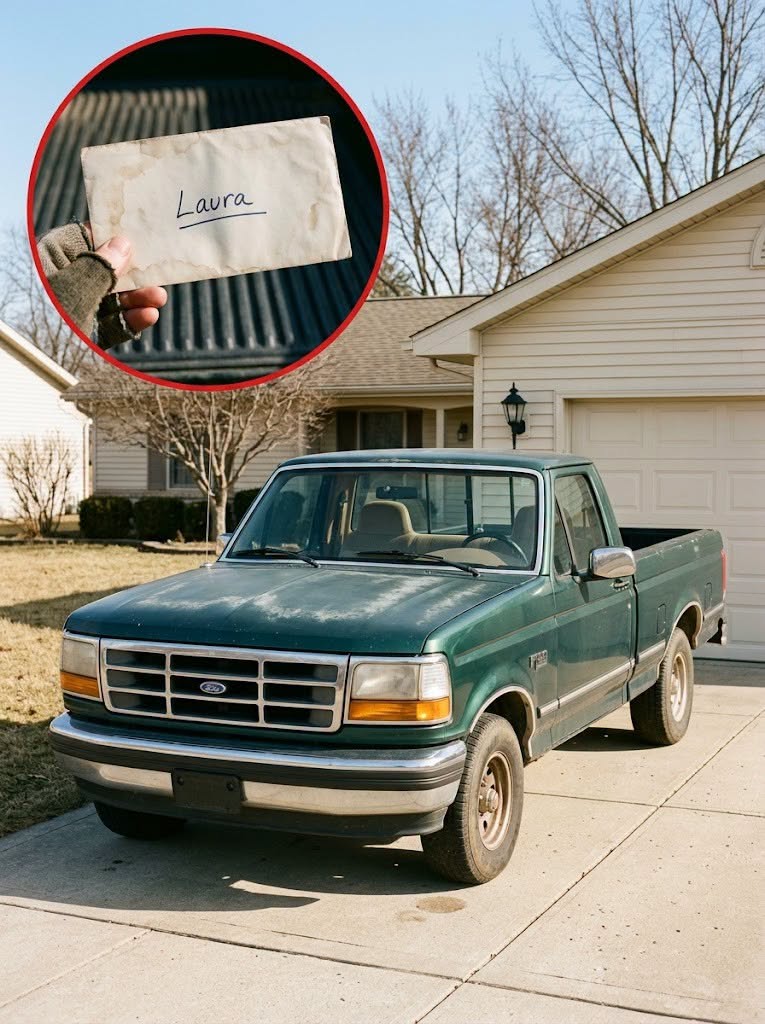
I found out when I drove past our father’s garage and saw an empty space where the green pickup had sat for almost twenty years. At first, I thought Derek had taken it somewhere for repairs. Then I called him.
“I sold it,” he said, his voice flat, as though he were telling me he’d sold an old lawn mower.
“You did WHAT?”
“The truck, Laura. It was sitting there collecting dust. We need to settle Dad’s expenses, and I got a decent offer.”
“We agreed not to touch anything for six months!”
“That was before I realized how much everything was going to cost.”
I stood in the driveway, gripping my phone so tightly my fingers hurt. Dad had barely been gone a month, and Derek had already sold the one thing our father had poured his heart into.
“You could have called me,” I whispered.
“And you would have said no. That’s exactly why I didn’t.”
Then he hung up.
For days, I couldn’t look at my brother without feeling a mixture of anger and grief. I knew Dad had left bills behind. I knew the house needed repairs. But the truck wasn’t just a vehicle to us. It was the sound of Dad humming along to old country songs, the smell of motor oil on his work shirts, and the place where he’d taught me that if something was broken, you didn’t automatically throw it away. You figured out how to fix it.
Derek had thrown away a piece of our father without even asking me.
I stopped answering his calls.
Then, on a rainy Thursday morning, my phone rang from an unfamiliar number.
“Hello, is this Laura Bennett?” a man asked.
“Yes.”
“My name is Michael. I bought a green Ford pickup from your brother a few weeks ago. A 1994 model. I was doing some cleaning underneath the driver’s seat when I found something that I think belongs to you.”
My heart started beating faster.
“What did you find?”
“An envelope. It’s sealed, and your name is written on the front. There’s also a note that says, ‘For Laura. Only Laura.’”
For a moment, I couldn’t speak.
Dad had been particular about everything in that truck. He knew every bolt, every wire, and every small imperfection. If he had hidden something beneath the driver’s seat, he had done it for a reason.
“Would you be willing to meet me?” I finally asked.
“Of course,” Michael replied. “I figured you should have it.”
We arranged to meet that afternoon at a small diner halfway between our towns.
When I arrived, Michael was already sitting in a booth near the window. The envelope lay on the table in front of him. It was yellowed around the edges, sealed with a strip of clear tape, and addressed in my father’s unmistakable handwriting.
I recognized the way he made the letter L, with its long downward stroke. I recognized the slight slant of every word.
My hands began to tremble.
“Your dad must have meant a lot to you,” Michael said gently.
“He meant everything.”
Michael slid the envelope toward me. “I didn’t read it. I thought that if he wrote your name on it, you should be the one to open it.”
I thanked him, and he left me alone.
For several minutes, I simply stared at the envelope. I ran my thumb over Dad’s handwriting, remembering the last time he had sat in that truck. He had been weak from treatment, his face pale, his hands thinner than I had ever seen them. Yet when Derek started the engine, Dad had smiled like a little boy.
I carefully broke the seal.
Inside was a folded letter and a small brass key attached to a paper tag. On the tag, Dad had written three words:
“The old toolbox.”
I unfolded the letter.
My sweet Laura,
If you’re reading this, then something has happened that I hoped would never happen. Either I’m gone, or someone has decided that the old truck is worth more than the memories we made in it.
I’m sorry I didn’t tell you about this sooner. I wanted to explain everything to you in person, but life doesn’t always give us the time we think we have.
You have always been the one who looked after things other people overlooked. When you were twelve, you spent an entire afternoon helping me find a missing socket because you knew how much it mattered to me. You didn’t know anything about tools back then, but you knew it mattered to your dad.
I’ve never forgotten that.
There’s something in my old steel toolbox in the garage. Use the key I’ve enclosed. What you’ll find inside is yours. It has always been yours.
Don’t let anyone convince you that you owe it to them. And don’t let anger take away the good memories you still have.
Love always,
Dad.
I read the letter twice, then a third time, tears blurring the words.
What had Dad hidden in his toolbox? And why had he gone to such lengths to make sure I received it?
I drove straight to his house.
The garage smelled exactly as it always had: grease, old wood, and the faint metallic scent of tools that had been used for decades. Dad’s steel toolbox stood against the back wall beneath a shelf of paint cans and spare parts.
I hadn’t opened it since the funeral.
The little brass key fit the lock perfectly.
Inside were rows of wrenches, screwdrivers, and sockets arranged with the precision Dad had always demanded. At first, I saw nothing unusual. Then I noticed that the bottom drawer sat slightly higher on one side.
I pulled it out and felt beneath the metal lining.
There was a second compartment.
Inside lay a thick manila folder, a small velvet pouch, and another envelope bearing my name.
I sat down on the cold concrete floor and opened the folder first.
The first document was a bank statement. The second was a certificate of deposit. Behind them were several investment records and a letter from an attorney.
I read the figures once, then again, struggling to understand what I was seeing.
Dad had quietly saved money for me for more than twenty years.
Every month, beginning shortly after my mother died, he had deposited a portion of his paycheck into an account in my name. Some months the deposits were small. Other months, when he worked overtime repairing engines, they were larger. He had reinvested the savings and left instructions for the account to remain untouched until he passed away.
The balance was far more than I had imagined.
It wasn’t a fortune that would make me wealthy overnight, but it was enough to pay off my mortgage, clear the debts I had accumulated during my mother’s illness, and give me a financial security I had never expected to have.
I pressed the papers against my chest and cried.
Dad had spent years telling me that he wasn’t a rich man. He’d worn the same work boots until the soles separated, repaired his own appliances, and driven a twenty-year-old pickup because he preferred fixing things to replacing them.
All that time, he had been quietly building something for me.
But the folder contained one more surprise.
The attorney’s letter explained that the account was separate from the estate and had already been legally designated for me. It also mentioned a handwritten instruction Dad had left concerning the truck.
I opened the second envelope.
Laura,
The truck was never meant to be your inheritance. It’s just metal, paint, and an engine, even if it holds some of our best memories.
The money is there to give you choices. The key is there to remind you of something more important.
You don’t have to spend your life proving that you’re worthy of being loved. You never did.
I know you and Derek don’t always see eye to eye. He has always been afraid of being the one who falls behind, even when nobody is racing him. I tried to teach him that love isn’t something you have to win, but I don’t know if he ever believed me.
If he sells the truck, let him. If he argues, don’t let the argument become the rest of your life.
You can’t keep every object that reminds you of someone. But you can choose what you carry forward.
And if you ever have to choose between being right and being at peace, I hope you’ll remember that peace doesn’t mean pretending you weren’t hurt.
It means deciding what your hurt will be allowed to take from you.
I love you, sweetheart. I always have.
Dad.
I sat in the garage until the afternoon light faded, holding that letter in my hands.
For weeks, I had believed Derek’s decision to sell the truck meant he didn’t care about what Dad had left behind. Now I understood that my father had known his children well enough to anticipate the possibility of conflict, even if he hadn’t been able to prevent it.
But understanding Derek didn’t erase what he had done.
The following morning, I called my brother.
“Can we talk?” I asked.
He sounded surprised. “About what?”
“Dad. The truck. Everything.”
There was a long silence.
“Laura, I know you’re angry,” he finally said. “I should have told you before I sold it.”
“Yes, you should have.”
“I needed the money. The funeral cost more than I expected, and there were bills coming in. I thought selling the truck was the easiest way to deal with some of it.”
“Then you should have talked to me. We could have figured something out together.”
“I know.”
For the first time since Dad’s death, Derek didn’t try to defend himself.
I told him about the letters and the account. I didn’t tell him the exact balance, because I wasn’t ready to discuss the money with anyone. I simply explained that Dad had left something specifically for me and that I had found it in the toolbox.
Derek was quiet for so long that I thought the call had dropped.
“Dad saved money for you?” he finally asked.
“Yes.”
“Did he leave anything for me?”
The question hurt more than I expected.
“I don’t know what Dad arranged for you. You need to speak with the estate attorney about your inheritance.”
“I just thought…” He stopped. “I guess I thought he trusted you more.”
I closed my eyes.
“Derek, I don’t think this was about trusting one of us more than the other. Dad knew me. He knew what I needed, just as he knew you had your own struggles. Whatever he left us, we can’t use it to measure how much he loved us.”
My brother exhaled shakily.
“I shouldn’t have sold the truck behind your back,” he said. “I’m sorry.”
It wasn’t a perfect apology. It didn’t bring back the truck or undo the weeks of anger. But it was the first honest thing he had said to me since Dad died.
A week later, Michael called again.
He had been going through the truck’s glove compartment when he found an old photograph tucked behind the owner’s manual. It showed Dad standing beside the pickup on the day he first brought it home, with a much younger Derek and me sitting on the hood.
“Would you like the picture?” Michael asked.
I told him I would.
When he mailed it to me, he included a short note. He explained that he had bought the truck because he had always wanted an older Ford to restore. After finding the letters, he had decided to keep it and finish whatever repairs it needed. He promised to preserve the truck’s original character rather than turn it into something unrecognizable.
I was grateful.
I couldn’t bring myself to ask him to sell it back. Dad’s words had made me realize that I was holding on to the truck partly because I was afraid that letting it go meant losing my father all over again.
It didn’t.
I framed the photograph and placed it on the shelf above my desk, beside the letter Dad had written me. I used part of the money he had saved to pay off my mortgage and put the rest into savings, just as he would have wanted.
Then, a few months later, Derek came over to help me clean out the garage.
We worked mostly in silence, sorting through old tools, rusty bolts, and boxes of things Dad had collected over the years. At one point, Derek picked up a wrench and smiled sadly.
“Remember when Dad made us spend an entire Saturday organizing these?” he asked.
“He said we couldn’t borrow anything until we knew where it belonged.”
Derek laughed softly. “I hated that.”
“You always hated organizing.”
“Yeah,” he said. Then his smile faded. “I miss him.”
“So do I.”
We stood there for a moment, two grieving children surrounded by the remains of a life that had once seemed permanent.
Eventually, Derek asked if I would ever forgive him for selling the truck.
I looked at the empty space where it had once sat.
“I think I’m getting there,” I said. “But forgiveness doesn’t mean it was okay. Next time something matters to both of us, I need you to talk to me instead of deciding for both of us.”
He nodded.
“I will.”
I don’t know whether he ever fully understood what the truck meant to me. Perhaps he never would. We had grown up in the same house with the same father, but we had carried different memories of him.
What I do know is that Dad had left me something far more valuable than money.
He had left me a reminder that love doesn’t always arrive as a grand gesture. Sometimes it looks like a man working overtime, depositing a little money each month, and hiding a letter where he hopes his daughter will someday find it.
Sometimes it looks like an old photograph, a worn toolbox, or a truck that someone else now drives down unfamiliar roads.
And sometimes it means learning that you can be deeply hurt by someone you love without allowing that hurt to define the rest of your relationship.
I still miss Dad every day. I still wish I could hear that old Ford’s engine rumble outside my window on a Sunday morning.
But when I look at his photograph, I no longer see only what was taken from me.
I see what he gave me.
And I finally understand why he hid that envelope beneath the driver’s seat.
He knew the truck might not stay in our family forever.
He wanted to make sure his love would.