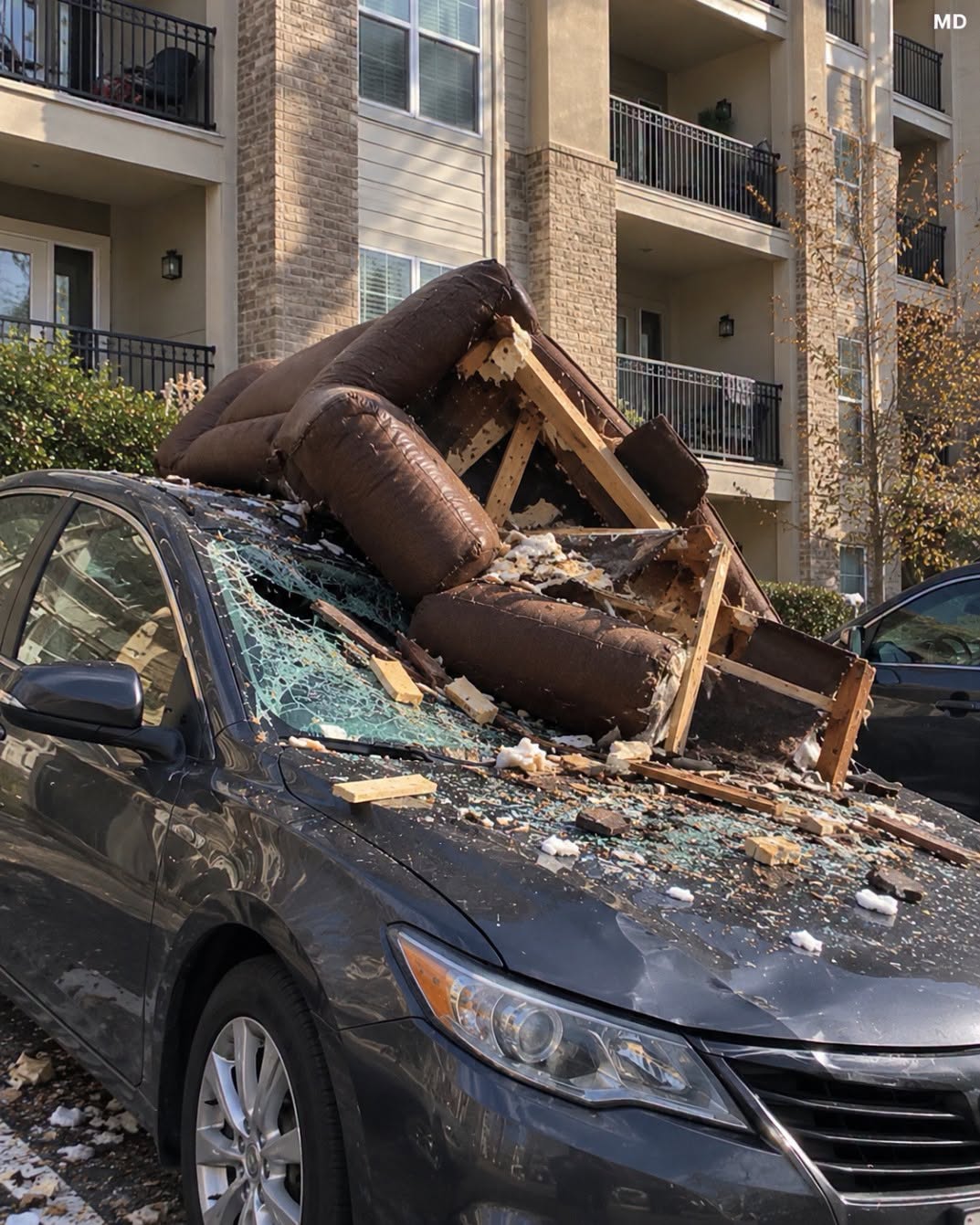
The sharp crash outside my apartment window made me freeze before I even reached the glass. It was around 9 p.m. on a Friday, and I had parked in my usual spot, the same place I had used for three years without a problem. When I looked outside, a wooden dining chair was shattered across my hood, while cracks spread across my windshield. Four floors above me, my neighbor Trevor leaned over his balcony and casually claimed the chair had “slipped.” I asked whether he would cover the damage, but he only said he would “think about it,” which told me everything I needed to know about the kind of person I was dealing with.
I stood beside my car, staring at the damage, trying to understand how someone could be so careless and so indifferent afterward. The repair bill would be expensive, and I had no intention of paying for something I hadn’t caused. I took photographs of the broken chair, the shattered windshield, and the dents across the hood. Then I looked up at Trevor’s balcony again. He had already disappeared inside, apparently convinced that closing his door would make the problem disappear.
The following morning, I contacted the apartment manager and filed an incident report. I also asked whether the building had security cameras facing the parking area. At first, the manager seemed reluctant to get involved, explaining that disputes between neighbors could become complicated. But when I showed him the photographs and explained exactly where the chair had landed, his expression changed.
“There may be something you should see,” he said.
He invited me into the management office and pulled up footage from the parking lot. The video showed Trevor carrying the wooden chair onto his balcony shortly before the crash. He placed it near the railing, walked away, and returned several minutes later. Then, instead of accidentally knocking it over, he appeared to push it outward.
The chair fell directly onto my parked car.
I watched the recording twice, barely believing what I was seeing. Whatever Trevor had told himself, the footage made one thing clear: this wasn’t simply a chair that had slipped from someone’s hands.
The manager saved a copy of the recording, and I contacted the police to report the damage. An officer came to take my statement and photographs. I also contacted my insurance company, which explained what documentation I would need to submit a claim.
By Monday afternoon, Trevor had apparently learned that the building management possessed the footage. He knocked on my apartment door, no longer wearing the careless smile I had seen from his balcony.
“Look,” he began, shifting uncomfortably, “I didn’t think it would cause that much damage.”
I folded my arms. “You dropped a wooden chair four floors onto my car. What exactly did you think would happen?”
He claimed he had been frustrated that evening and hadn’t considered where the chair would land. He offered to pay a small amount immediately and suggested we forget about the incident before it became a bigger problem.
But I wasn’t interested in pretending nothing had happened.
I told him that any payment would need to cover the documented damage and that I would continue working through the proper channels. I wasn’t going to accept a vague promise or let him decide how much responsibility he wanted to take.
Over the next several days, the repair estimate arrived. The windshield needed replacing, and the hood required substantial work. With the photographs, the security footage, and the incident report, I finally had the evidence needed to support my claim.
Trevor eventually stopped trying to convince me that the chair had slipped. The apartment manager also reminded residents that throwing or dropping objects from balconies could endanger people below and violate the building’s rules.
My car was repaired a few weeks later, and I returned to my usual parking space. The spot looked exactly as it had before, but I no longer took my surroundings for granted.
The experience taught me something I wish I had learned earlier: someone else’s carelessness does not automatically become your responsibility just because they refuse to accept the consequences.
Trevor had expected me to get angry, argue with him, and eventually give up. Instead, I documented everything, asked for help, and let the evidence speak for itself.
I never needed revenge. I needed accountability.
And sometimes, the most powerful response to someone who thinks they can get away with anything is simply refusing to let them walk away from what they’ve done.