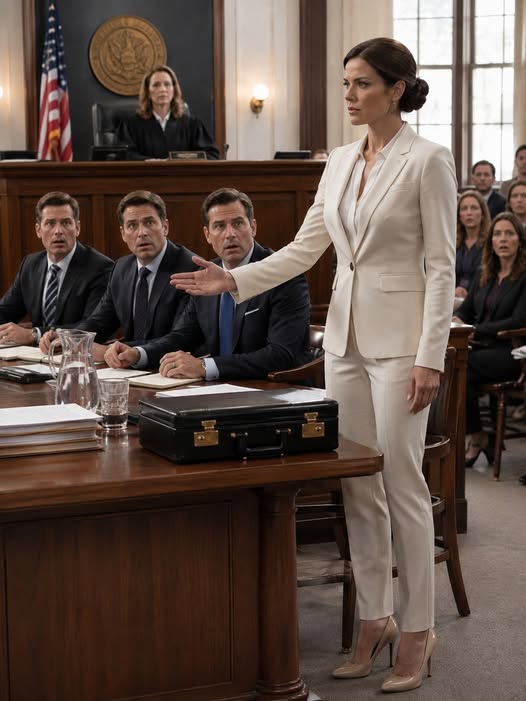
“From the same place they thought I was too broke to look.”
I let the sentence sit there.
Judge Robles looked down at the document again.
“Who signed the original?”
“Preston Vance,” I said.
“And the second signature?”
I turned the page.
“Richard Vance.”
Richard shifted in his chair.
“That document is confidential,” he said.
Judge Robles looked over her glasses.
“Mr. Vance, you are not represented in this proceeding.”
Richard’s mouth closed.
I could see Martin Voss calculating.
He had walked into the courtroom expecting an unrepresented wife with no money, no lawyer, and no understanding of corporate finance.
Now he was staring at documents that appeared to connect the marital assets directly to companies controlled by his own clients.
“Your Honor,” Martin said carefully, “my clients maintain that these documents have been taken out of context.”
“I agree that context matters,” I said.
Martin turned toward me.
“Mrs. Vance, you’re not qualified to offer a forensic accounting opinion.”
“I’m not offering one.”
I slid another page across the table.
“I’m identifying records.”
That distinction mattered.
It was the kind of distinction I had learned to make years ago when every word in a courtroom could become a problem if you weren’t precise.
Judge Robles examined the pages.
“Explain what I’m looking at.”
I took a breath.
“The first transfer occurred four months before my marriage to Preston.”
I pointed to the date.
“Money moved from Vance Commercial Holdings into an entity called North Shore Property Partners.”
“That company wasn’t owned by Preston directly.”
Martin interrupted.
“Objection.”
“Overruled for now,” Judge Robles said.
I continued.
“Three days later, North Shore purchased a property on East Delaware Place.”
I turned another page.
“Two years into my marriage, that property was refinanced.”
The refinancing documents showed a familiar name.
Preston Vance.
“Then the proceeds moved again,” I said.
“From North Shore to another Vance-controlled entity.”
Judge Robles followed the sequence with her finger.
“And you’re saying this happened repeatedly?”
“I’m saying the records show a pattern.”
Preston finally spoke.
“Amelia, you have no idea what you’re talking about.”
I looked at him.
“I used to believe that.”
His expression tightened.
That was the strange thing about the years I had spent pretending to be someone else.
People assumed silence meant ignorance.
It didn’t.
Sometimes silence simply meant you were waiting until speaking would matter.
I had noticed the transfers long before Preston served me the divorce papers.
At first, I hadn’t thought much of them.
Vance Enterprises owned dozens of properties and dozens of subsidiary companies.
Money moved constantly.
That was normal.
What wasn’t normal was how carefully certain transfers disappeared from the documents Preston gave me to review.
He had always asked me to organize agreements before major acquisitions.
He liked having me check dates, signatures, addresses, and obligations.
He called it administrative work.
I knew better.
Legal documents had a language of their own.
They left fingerprints.
And over the years, I had noticed the same names appearing in different places.
North Shore Property Partners.
Lakefront Capital.
Vance Residential Holdings.
Different companies.
Different addresses.
Different stated purposes.
But the same registered agent.
The same bank.
And, in several records, the same flow of money.
I had never accused Preston.
Not then.
I had trusted my husband.
That trust ended the morning he placed the divorce petition beside my coffee.
After he left the townhouse that morning, I didn’t cry.
I read the papers again.
Then I noticed something that made me stop.
The petition claimed Preston’s assets were entirely separate from the marriage.
That was an unusually confident statement.
Too confident.
So I began checking every financial document I already had lawful access to as a spouse and every document that had been exchanged in connection with our divorce proceedings.
I didn’t hack anything.
I didn’t steal anything.
I didn’t break into an account.
I simply read what they had already put in front of me.
And the more I read, the more obvious the pattern became.
Their strategy wasn’t merely to divorce me.
They wanted me to sign away any possible claim before I had time to understand what those claims were worth.
They had even prepared a settlement acknowledgment stating that I had made no meaningful contribution to the acquisition, maintenance, or growth of marital assets.
That statement bothered me.
Not because they insulted my work.
Because it wasn’t true.
For seven years, I had helped Preston with contracts, schedules, negotiations, vendors, corporate events, property inspections, and communications.
I had attended meetings where his father wasn’t present.
I had reviewed drafts late at night while Preston slept.
I had flagged language that could expose his company to liability.
And sometimes, I had caught things his expensive attorneys had missed.
Preston knew that.
His father knew it too.
They simply believed nobody would make them prove otherwise.
Judge Robles turned another page.
“Mrs. Vance, I want to understand the second document.”
I handed it to her.
It was a private memorandum dated six months after my wedding.
At the bottom were two signatures.
Preston Vance.
Richard Vance.
The memorandum described a transfer of funds to one of the companies listed in the first exhibit.
The amount was substantial.
But the money wasn’t the part that mattered most.
The memorandum contained a sentence stating that the transferred funds would be used to “preserve family-controlled assets while minimizing outside marital exposure.”
Martin Voss stood immediately.
“Your Honor, I object to the characterization.”
“I haven’t characterized anything,” I replied.
Judge Robles raised her hand.
“Counsel, approach.”
Martin walked toward the bench.
Richard whispered urgently to him.
Vivian leaned toward Preston.
For the first time since the hearing began, the Vance family looked less like a wealthy dynasty and more like a group of people trying to figure out what the person sitting across from them already knew.
The judge returned to the bench.
“I am ordering the parties to preserve all financial records related to the entities identified in these exhibits.”
She looked at Martin.
“I also want supplemental disclosure regarding the transfers.”
Martin’s face hardened.
“Your Honor, that is premature.”
“No,” Judge Robles said.
“It is prudent.”
Richard’s chair scraped against the floor.
“This is a divorce case,” he said.
“Not an investigation into my company.”
Judge Robles looked directly at him.
“Then you should have no difficulty producing the records.”
Nobody laughed.
I returned to my chair.
Preston watched me.
His expression wasn’t angry anymore.
It was frightened.
During the recess, he followed me into the hallway.
“Why are you doing this?”
I stopped.
“You asked me to sign away everything.”
“I was trying to make this clean.”
“You were trying to make it permanent.”
He lowered his voice.
“You don’t understand what you’re starting.”
I almost smiled.
“That’s what your father said when he told me I was too broke to afford a lawyer.”
Preston looked away.
I could see the question forming in his face.
Who had helped me?
Who had found the documents?
Who had prepared the exhibits?
The answer was simpler than he wanted.
Me.
I had spent more than a decade as a military attorney.
I had worked cases where people had hidden millions behind layers of paperwork and assumed nobody would notice.
I had learned how investigators think.
I had learned how fraud is disguised.
I had learned that the most important evidence isn’t always the most dramatic piece of paper.
Sometimes it’s the boring one.
The invoice.
The transfer.
The date.
The repeated address.
The signature.
The little things that become impossible to explain when they all point in the same direction.
“You were always supposed to stay out of the business,” Preston said.
“I did.”
“You were my wife.”
“I was.”
He swallowed.
“Then why did you keep all of this?”
I looked at him.
“Because once you served me those papers, I stopped being your wife.”
His face went still.
“I became the respondent.”
The bailiff called us back into the courtroom.
When we returned, Judge Robles had another document in front of her.
“This item was submitted by Mrs. Vance during the recess,” she said.
Martin immediately stood.
“Your Honor—”
She cut him off.
“Counsel, I haven’t said what it is yet.”
The document was a corporate resolution.
It concerned a property that Preston had claimed was acquired with his separate funds before the marriage.
The resolution, however, was dated eight months after our wedding.
And the funding source listed on the final page was a joint account.
Our joint account.
Martin looked at Preston.
Preston looked at Richard.
Richard looked at Vivian.
For several seconds, none of them spoke.
Judge Robles asked, “Mr. Vance, is this your signature?”
Preston stared at the page.
“Yes.”
“Did you authorize this transfer?”
He hesitated.
“Yes.”
“And was Mrs. Vance’s name on the account from which the funds originated?”
Another pause.
“Yes.”
The judge nodded.
“Then the issue before this court is substantially different from the one presented in the initial petition.”
Martin sat down.
I didn’t feel victorious.
I felt tired.
Because suddenly, the last seven years were no longer being discussed as hostess duties.
They were being examined as evidence of contribution.
And that was only half of what I had found.
The final document in my folder had been the hardest one to decide whether to bring into court.
Not because it was complicated.
Because it involved Preston.
It was an email.
Sent three days before he handed me the divorce petition.
The subject line read:
KEEP AMELIA OUT OF THE BOOKS.
The sender was Richard.
The recipient was Preston.
The message contained only a few sentences.
It instructed Preston to finalize the divorce paperwork before I could review the upcoming restructuring of several properties.
At the bottom, Richard had written one final sentence.
“She’ll sign if she thinks she’s broke.”
I looked at Preston.
He closed his eyes.
Judge Robles read the email in silence.
Then she looked toward Martin.
“Counsel, do you have an explanation for this?”
Martin remained seated.
“No immediate explanation, Your Honor.”
Richard stood.
“This is a private family communication.”
“It may also be relevant evidence,” Judge Robles replied.
Richard’s voice rose.
“You can’t let her turn my son’s divorce into an attack on my company.”
Judge Robles’ expression hardened.
“Mr. Vance, you have been given repeated opportunities to let counsel address the proceedings.”
Richard sat.
I looked down at my hands.
They were steady.
That surprised me.
For weeks, I had imagined this moment.
I had imagined anger.
I had imagined shouting.
I had imagined finally telling them exactly what I thought of them.
But when the moment came, I wanted none of that.
I wanted the truth on the record.
Nothing more.
The court ordered additional financial disclosures, preservation of relevant records, and a detailed accounting of the properties and transfers identified during the hearing.
The divorce did not end that afternoon.
Neither did the financial dispute.
The Vances had expected a quick signature and a quiet exit.
Instead, their own records forced the case into a much closer examination of what belonged to whom.
Some assets were ultimately determined to be separate.
Others were not.
Several transactions required further investigation and accounting.
The final settlement was negotiated months later, after both sides had reviewed the financial records in detail.
I received a fair division of the marital assets to which I was legally entitled.
More importantly, the settlement did not erase my contribution or allow anyone to rewrite seven years of my life as “hostess duties.”
Preston lost far more than money.
He lost the version of me he thought he could control.
We never reconciled.
Richard never apologized.
Vivian never admitted that she had underestimated me.
And I didn’t need any of them to.
A few months after the case ended, I moved into a smaller apartment overlooking the lake.
There were no marble countertops.
No country club invitations.
No family dinners where everyone measured your worth by the price of your clothes.
On the first morning there, I made coffee and opened the window.
The city sounded different from that apartment.
Less like something I had to perform for.
More like something I was finally allowed to live in.
My old leather tote sat beside the chair.
The red exhibit folder was still inside.
I took it out one last time.
The papers were no longer needed.
I removed the first page and looked at the words that had once made my stomach tighten.
No financial contribution by the respondent.
I folded the page in half.
Then I placed it in the recycling bin.
The red folder stayed.
I kept it empty.
Not because I expected another courtroom battle.
Because it reminded me of something I had forgotten during those seven years.
I had never been the woman who needed rescuing.
I had simply spent too long letting people believe I was.