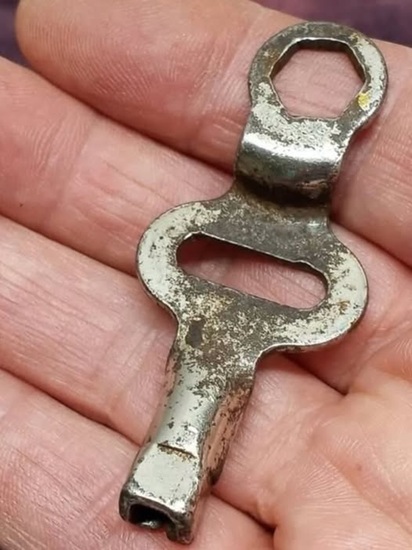
At first glance, this small metal object can be surprisingly difficult to identify. Its narrow shaft, simple handle and unusual slot do not immediately resemble the kitchen tools commonly used today. For people familiar only with pull tabs, ring-pull lids and modern rotary can openers, the object can look more like a tiny piece of hardware than something connected with food packaging. In reality, this type of tool belonged to an earlier generation of can-opening technology.
It is commonly known as a twist key, winding key or can key, and it was designed to open cans equipped with a specially prepared tear strip. The basic idea was straightforward but mechanically clever. Instead of cutting around an entire lid with a separate opener, the can itself included a narrow strip of metal that had been weakened or scored along its edges. One end of that strip formed a small tab. The user inserted the tab into the slot in the key and then rotated the key by hand.
As the key turned, the metal strip wrapped around the shaft and gradually separated from the can. The rolling action effectively peeled open the container and provided access to the food inside. This method has a long history in commercial packaging. A key-based opening system was patented in the United States by J. Osterhoudt in 1866.
The concept allowed a strip of metal to be rolled around a key instead of requiring the entire lid to be cut away. Historical packaging records show that key-wind cans later became familiar with sardines and other foods packaged in metal containers. The technology therefore predates many of the easy-open designs that are now considered ordinary.
Sardine tins became especially strongly associated with these little keys. Flat rectangular cans containing sardines or similar preserved fish were often manufactured with an opening strip and a key provided specifically for that package. A buyer did not necessarily need to search a kitchen drawer for a separate opener because the tool could be supplied with the can itself. Historical sources also show that manufacturers and retailers once treated the presence of a key as a convenience worth mentioning when selling canned goods.
Using the key required only a few actions. First, the user found the exposed end of the tear strip. That small piece of metal was inserted through the narrow slot in the key. The key was then turned so that the strip began winding around its stem. Each additional rotation pulled another section away from the can. The strip eventually formed a tight coil around the key while the opening in the container became large enough to reach the contents.
The slot was therefore the most important working feature of the tool. Without it, the key would have had nothing to grip securely. Once the tab entered the slot, the key and strip effectively became connected. Turning the handle converted a simple twisting movement of the hand into a controlled pulling force on the metal band. Historical patents describe this same basic action: the tab entered a slot and the strip was wound around the key while being torn from the can.
The rolling motion offered an important mechanical advantage. Trying to peel a narrow strip of sheet metal directly with bare fingers would be awkward and potentially hazardous. Wrapping the strip around a rigid shaft allowed force to be applied gradually and consistently. The key also kept much of the removed strip together as a coil instead of leaving a long loose piece of metal. This was an efficient solution created with very few parts.
One historical patent from 1945 even focused on improving this type of opener by making the coil easier to remove from the key after the can had been opened. The patent described a slotted stem that received the tab and wound the tear strip around itself. It also discussed a mechanism for stripping the resulting coil from the shaft. That document is useful evidence that this opening method had become familiar enough to inspire later refinements rather than remaining an isolated invention.
The can itself was just as important as the key. These tools did not work by magically opening any ordinary metal container. The package had to be designed specifically for a tear-strip system. A scored or weakened band was incorporated into the can, and the exposed tab gave the key a starting point. Without that prepared strip, a twist key could not simply replace a conventional can opener.
Different containers could place the opening band in different positions. Some designs used a strip near the top of the can, while others incorporated it along the body. Historical descriptions of key-wind cans note that the scored band could appear on the side or top depending on the packaging design. Once the band was removed, the corresponding section of the container separated and the food could be accessed.
The system also appeared on products beyond sardines. Historical sources describe key-wind opening methods on other kinds of canned meat and foods. The flat sardine tin became one of the most recognizable examples, but the underlying principle could be adapted to different container shapes. What mattered was the presence of a suitable tear strip and a compatible winding key.
For many consumers, the key was supplied directly with the package. This solved a practical problem that is easy to underestimate today. Early canned foods were useful because they preserved food for long periods, but opening the containers was not always convenient. A purpose-built key meant the manufacturer could provide the opening device together with the food. The buyer only needed to detach or retrieve the key and use it as intended.
This explains why the object can look unusually small compared with modern kitchen tools. It was not meant to be a large, permanent appliance with gears and cutting wheels. Many keys were simple pieces of metal designed to perform one specific task efficiently. Their modest dimensions helped keep manufacturing costs low and made them easy to attach to the can.
Some examples were intended essentially as single-use tools. A historical patent describing the familiar opening method noted that individual keys were commonly attached to cans and could be discarded after use along with the wound strip. That same patent proposed a reusable version because the ordinary practice involved providing a key with each container. This helps explain why countless examples were inexpensive and minimally constructed.
The simplicity of the design should not be mistaken for poor engineering. The system matched the package and tool very closely. The can provided a weakened path for the metal to tear. The tab gave the key a grip point. The slot held the tab, and the shaft provided the surface around which the strip could coil. The user’s hand supplied the rotational energy. Every element had a clear purpose within the opening process.
In operation, the can key worked almost like a tiny winding device. Once the first section of strip was secured, each turn increased the amount of metal wrapped around the shaft. The growing coil also gave the user something substantial to continue rotating. The motion stayed controlled as long as the strip tore along the intended scored lines.
That control was important because sheet metal can develop sharp edges after being torn. The winding method reduced the need to grasp the detached strip directly. Even so, old-style cans could still produce sharp exposed edges, so the system was not necessarily safer in every respect than modern easy-open packaging. It was simply a practical solution suited to the materials and manufacturing methods of its era.
The design became particularly familiar during periods when canned foods were common household staples and easy-open aluminum lids had not yet become widespread. A person who grew up seeing tins equipped with these keys might recognize the object instantly. Someone encountering the same tool today without its original can may have almost no visual clue about its purpose.
That loss of context explains much of the mystery surrounding vintage examples. A loose key found in a drawer, toolbox or antique collection no longer has the package that explained how it worked. The slot may resemble part of a mechanical fitting. The handle can look like a miniature wrench or hardware component. Only when the original tear-strip system is understood does the object’s shape become obvious.
The history of the mechanism also reveals how much packaging technology has changed. Modern consumers are accustomed to lifting a ring tab, peeling back a foil seal or using a standard can opener. Those methods did not always exist in their present form. Earlier manufacturers experimented with numerous ways to make sealed metal containers easier to open.
The twist-key system was one of those important solutions. Historical summaries of can-opening technology identify Osterhoudt’s 1866 patent as an early key-based method that allowed a thin strip of the can to be wrapped around a supplied key. This meant the package could be opened without using the same kind of cutting mechanism found in later general-purpose can openers.
A key-wind can was therefore really a coordinated packaging system rather than just a can plus a random accessory. The metal container had to be manufactured with the correct scored strip. The strip needed a usable starting tab. The key required a slot that matched that tab. Each component depended on the others.
This kind of integrated design was useful for commercial food packaging because the manufacturer could control the entire opening method. A consumer did not need a particular brand of household opener. As long as the attached key had not been lost, the package contained the tool required to access its contents.
Losing the key, however, could create an obvious problem. Without the original winding tool, opening the package as designed became more difficult. People could sometimes improvise with another suitable object, but the convenience of the system depended heavily on keeping the key available until the can was needed.
This is one reason keys were often physically attached to cans. The attachment reduced the chance that the small tool would become separated from the package during transportation, storage or sale. When the consumer was ready to open the container, the key could be detached and immediately used.
The connection between keys and canned fish became so strong that the objects are frequently called sardine-can keys even though similar mechanisms appeared on other packaged foods. Flat fish tins made the system particularly memorable because their shape suited a controlled strip-opening arrangement. The association survives today even among collectors and people interested in vintage kitchen equipment.
The term “twist key” is also descriptive because rotation is the defining action. The tool does not primarily cut through the lid like a modern rotary opener. Instead, it twists and winds a strip that has already been engineered to separate from the container. That distinction helps explain why the tool looks so different from most current can-opening devices.
Another useful term is “key-wind can.” Archaeological and historical packaging sources use this expression for containers with a scored metal band that could be rolled back with a key. This terminology reflects the fact that the opening mechanism was part of the can’s design rather than a completely independent kitchen implement.
The key’s basic mechanical principle remained remarkably consistent across decades. A 1906 patent for a key-opening sardine can described a narrow slot receiving part of the tearing strip so that the strip could be wound around the key. A 1945 patent described essentially the same fundamental action while proposing improvements to the key itself. The persistence of the mechanism shows that it was simple enough to remain useful over a long period.
Manufacturers could modify details while preserving that basic principle. The shape of the handle might vary. The length and width of the shaft could differ. Some designs could be optimized for particular packages, while later patents attempted to improve handling or make keys reusable. The essential combination of tab, slot, rotation and winding remained recognizable.
The metal coil left behind after opening is another distinctive feature. Instead of producing a loose straight strip, the process wrapped the removed band tightly around the key. Historical patent drawings and descriptions explicitly show the tear strip becoming a coil during use.
That coil provides a useful clue when unidentified vintage objects are found with metal still wrapped around them. A key accompanied by a narrow spiral of sheet metal may reveal that it once opened a tear-strip can. Without the coil or original package, identification can be more difficult.
The tool also illustrates how small mechanical advantages can make everyday tasks much easier. A user did not require an electric motor, gears or complicated leverage. Rotation around a shaft converted hand movement into steady pulling tension. It is a simple example of mechanical design serving a very specific domestic purpose.
Earlier households contained many tools of this kind. Some were dedicated to opening bottles, jars or particular styles of cans. Others were shaped around the packaging conventions of a specific period. As containers became more standardized or easier to open, some of these specialized objects gradually disappeared from ordinary kitchens.
Modern easy-open lids changed expectations considerably. Pull tabs allow many containers to be opened without any separate implement. Peel-back seals perform a similar role on lighter packaging. Standard rotary can openers can handle a broad range of conventional cans. As these alternatives became common, a specialized key attached to each package became less necessary.
The older system did not disappear everywhere at the same time. Some canned products continued using winding keys long after newer opening technologies had appeared. Historical summaries note that variations of the system survived especially in some canned-fish packaging even after pull-style openings became increasingly common.
That overlap means the tool should not be assigned to one extremely narrow date without additional evidence. The underlying key-wind technology dates to the nineteenth century, but examples continued to appear in later decades. The exact age of an individual key would require information about its manufacturer, packaging, markings or archaeological context.
This is an important distinction when describing unidentified vintage objects. Knowing what a tool is does not automatically reveal exactly when that specific example was made. A similar key could have been manufactured many years after the opening system was first invented. Responsible identification separates the history of the design from the date of the individual object.
The same caution applies to unusual openings or shapes in the handle. Some vintage keys have decorative or structural openings, and individual manufacturers produced different forms. Without documentation for a particular model, it is unsafe to assume that every hole or geometric shape was deliberately intended as a wrench or appliance-adjustment feature.
That point matters because old tools often attract imaginative explanations online. A small hexagonal or round opening can tempt observers to assign a second mechanical purpose to it. Such a function may exist on a specific documented model, but it should not be generalized to all can keys unless reliable evidence identifies that use.
What is firmly established is the primary winding function. Historical patents describe the slot receiving the tear-strip tab and the key being rotated to wind away the metal. Museum and archaeological sources likewise document key-wind cans and their use with sardines and other foods. That evidence is sufficient to explain why these objects existed and how they worked.
This also makes the tool an interesting object for collectors. Vintage kitchen utensils often preserve aspects of everyday technology that disappeared without much ceremony. A device once considered completely ordinary can become mysterious once the packaging system it belonged to is no longer familiar.
Collectors may value these objects not because they are mechanically complex but because they represent a recognizable period in industrial design. Their shapes reveal how manufacturers solved practical problems with inexpensive materials and minimal components. A tiny can key can therefore tell a larger story about food preservation, packaging and household habits.
Archaeologists can also use can-opening technology as one piece of evidence when examining historical sites. Reports have identified strip-type can keys in archaeological collections and linked key-wind cans with specific periods of packaging development. Such objects can contribute to understanding how manufactured goods were distributed and consumed.
This broader context makes the tool more interesting than its appearance might suggest. It belongs to the history of mass-produced food and the effort to make sealed containers both durable and practical for consumers. The challenge was not merely preserving the contents. Manufacturers also had to provide a realistic way for buyers to get inside the package.
Early canned foods could be notoriously difficult to open because strong metal containers were originally designed with preservation and durability as the main priorities. As can manufacturing improved and metal became thinner, inventors developed increasingly specialized opening methods. The key-wind system represented one solution within that longer technological evolution.
What made the twist key effective was that much of the “cutting” work had already been engineered into the container. The scored strip defined where the metal should separate. The key mainly supplied controlled tension and rolling force. This is very different from a general-purpose opener that must create its own cutting path through an intact lid.
That difference explains why the old key appears almost too simple to be a real kitchen tool. It did not need a sharp rotating wheel or complicated handles because the can itself contained the prepared opening path. Its simplicity was possible precisely because the packaging and opener were designed as a system.
There was also an economic advantage in making the tool small. A disposable or package-specific key needed to add as little cost and weight as possible. A stamped or formed metal component could accomplish the task without requiring a sophisticated mechanism.
A large permanent handle would have been unnecessary for many products. The key only needed to provide enough grip for a person to rotate the strip around the shaft. Once the package had been opened, the tool’s primary job was complete.
This helps explain why many surviving examples can look crude compared with modern utensils. Their value came from function, not decoration. They were commercial packaging accessories designed to work reliably and cheaply.
For people who remember using them, the action can be immediately familiar. The tab went through the slot, the key was turned, and a thin strip of metal gradually curled around the shaft. For people who have never handled this kind of package, the object can remain almost impossible to identify without explanation.
That generational difference is one reason images of vintage tools perform so well as identification puzzles. The object itself has not become more complicated. What has disappeared is the shared everyday knowledge that once explained it.
An old key can therefore reveal how quickly familiar technology becomes unfamiliar. One generation may regard a household object as ordinary, while another encounters the same item as a mystery. Packaging design changes quietly, and the tools associated with older systems gradually vanish from daily routines.
The shift toward ring pulls and other easy-open systems contributed to that disappearance. These newer designs move the opening mechanism directly into the lid and eliminate the need to keep track of a separate key. From a consumer perspective, this can make the package simpler to use.
Yet the older twist-key design still has a certain mechanical elegance. Very little material was required. There were almost no moving components. The user supplied the motion, and the can’s own tear strip guided the opening process.
That combination of economy and function is why the design remained in use for so long. Technologies do not always need to be complicated to be effective. Sometimes a narrow slot and a piece of metal are enough when the surrounding system has been designed intelligently.
The object also demonstrates how the meaning of a tool depends on context. Place it alone on a table and it may resemble an unidentified fragment of hardware. Attach it to a tear-strip sardine tin and its purpose becomes almost self-explanatory.
Each visible feature suddenly has a reason to exist. The handle gives the fingers something to hold. The shaft provides a winding surface. The slot captures the metal tab. The can provides the scored strip that completes the system.
This is why identifying vintage objects can require more than recognizing their shape. Understanding the technology around them is often essential. A tool designed for a vanished packaging system may make little sense until that original environment is reconstructed.
The can key is an especially good example because the operation is so different from what many people now associate with opening canned food. Modern openers cut, pierce or pull. The traditional winding key peeled away a prepared strip by rolling it into a coil.
Although sardines are strongly associated with this design, it is more accurate to describe the object broadly as a tear-strip can key when the original package is unknown. Historical evidence confirms that related mechanisms appeared on other cans as well. Calling every unidentified example specifically a sardine key can therefore be more precise than the evidence allows.
If an object is found still attached to its original sardine tin, the identification becomes straightforward. If it is discovered alone, the safer description is a twist key or key-type can opener intended for a scored tear-strip container.
That distinction keeps the description factual while preserving the historical significance of the tool. It avoids turning a plausible association into a certainty without supporting evidence.
The same principle should be applied to any supposed secondary function. Unless markings, patents, manufacturer documentation or matching historical examples demonstrate that a particular opening in the handle served another purpose, that interpretation should remain tentative rather than being presented as established fact.
The primary function, by contrast, is well documented across multiple historical sources. A tab entered the slot. The key rotated. The metal strip wound around the shaft and separated from the can. This simple sequence is the heart of the design.
Looking at the tool through that historical context transforms it from a mysterious piece of metal into an understandable household object. It belonged to a period when cans and their opening devices were often designed together rather than treated as completely separate products.
Its disappearance from most kitchens says as much about changing packaging as it does about changing tools. When manufacturers changed the container, the accessory became unnecessary. The key did not fail mechanically; the problem it solved was redesigned.
That pattern appears throughout everyday technology. Objects vanish not always because a better version of the same tool replaces them, but because the system around them changes enough that the tool is no longer required.
The vintage can key is therefore both practical history and packaging history. It reflects a time when opening a sealed metal container involved a small dedicated device attached to the package. It also shows how inventors used a simple mechanical principle to solve a repetitive household task.
Today, someone finding one at the back of an old drawer may understandably mistake it for a tiny wrench, machine part or unidentified key. Its real function becomes clear only when the tear-strip can is brought back into the story.
Once that original use is understood, the design seems remarkably logical. The narrow slot grips the tab, rotation provides the pulling force, and the metal strip coils around the shaft as the container opens.
There is no need to exaggerate the object’s purpose to make it interesting. Its documented history is already compelling. A small, inexpensive key helped millions of packaged cans become easier to open during an era before today’s familiar easy-open lids.
What now appears unusual was once an ordinary example of practical industrial design. The technology connected the package, the tool and the user’s hand in a simple mechanical sequence that required almost no specialized equipment.
That is ultimately what makes the object worth remembering. It is not merely an unidentified piece of metal from an old kitchen. It is evidence of how everyday problems were solved before modern packaging made those solutions largely invisible.
The traditional winding key reminds us that even the smallest household objects can contain a surprising amount of technological history. Its job was straightforward, its construction was minimal, and its operation depended on a clever partnership between tool and container.
A century after the basic key-opening system emerged, newer packaging gradually reduced the need for these little tools. But surviving examples still preserve the logic of the original design.
Insert the tear-strip tab into the slot, turn the key and allow the metal to wind around the shaft. That was the entire idea, and it worked well enough to remain recognizable across many decades of canned-food history.
For anyone encountering the object today, that simple explanation solves the mystery. What looks like a strange miniature key was actually an efficient opener made for a very specific kind of metal can — a small reminder of how much everyday technology can change while leaving behind objects whose original purpose is easy to forget.

